How Turnitin Trains Its AI on Billions of Student Papers: A Technical Deep Dive
Few companies sit at the crossroads of education and technology quite like Turnitin. For more than two decades, the company has operated one of the world’s largest repositories of academic writing—billions of student papers, institutional submissions, web pages, and scholarly articles—supporting originality checks for schools and universities around the globe.
As artificial intelligence has reshaped how we write and verify writing, Turnitin has expanded beyond similarity detection into authorship analysis, AI writing detection, and pedagogical feedback. But how, exactly, does AI fit into a system powered by so much text? And what does it mean—for students, educators, and institutions—when AI tools are trained or evaluated in the context of this massive corpus?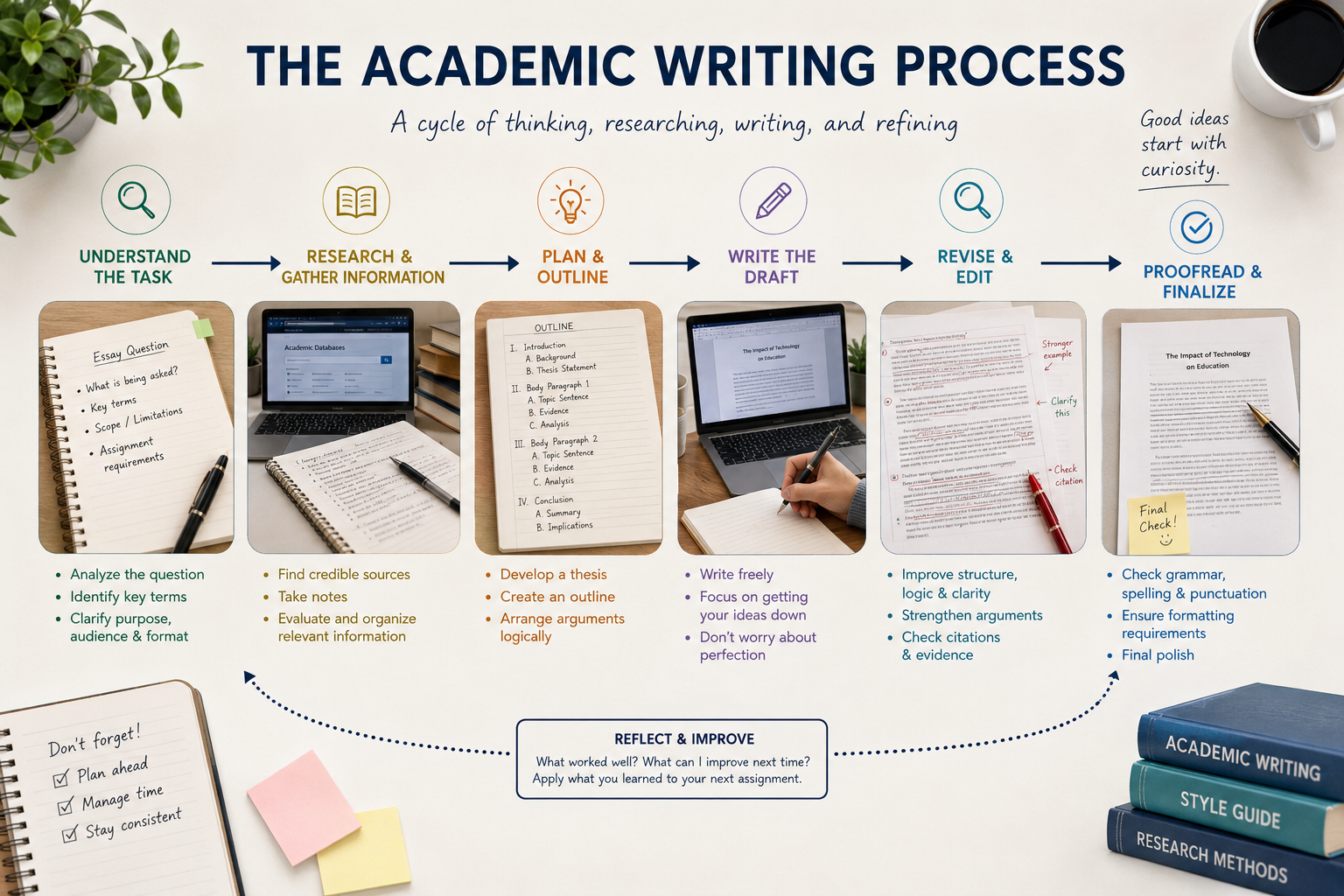
Understanding What “Turnitin’s AI” Actually Refers To
“AI” covers a range of capabilities. In academic integrity systems, it’s helpful to separate two layers: the reference corpus that powers similarity checks and the machine learning models that make predictions about text characteristics (such as the likelihood of AI authorship or stylistic consistency).
Similarity Matching vs. AI Writing Detection
Historically, Turnitin’s core technology has been originality checking: the system compares a new submission to a vast index of prior student papers, institutional repositories, web content, and publisher databases to find overlapping sequences of text. This process relies heavily on scalable indexing, document fingerprinting, and string matching—not necessarily on deep neural networks. Its purpose is to surface matches and percentages, not to “decide” whether something is plagiarized (that determination remains with the instructor).
More recently, vendors in this space, including Turnitin, have introduced AI writing detection and authorship analysis. Since its launch in April 2023, Turnitin’s AI writing detection tool has reviewed over 200 million papers, with data showing that more than half of students continue to use AI to write their papers.
These models try to estimate the likelihood that a passage was generated by a large language model or detect sudden deviations in a student’s writing style across assignments. Unlike simple matching, these capabilities typically are machine learning-based and require training on labeled examples of human and AI-generated writing.
The Role of the Corpus vs. Model Training
It’s important to distinguish between two uses of data:
Reference indexing: Billions of documents are stored and indexed so that future submissions can be compared against them. This is the backbone of similarity checking.
Model training and evaluation: Separate datasets (which may include public corpora, licensed content, synthetically generated texts, and, where permitted, de-identified or consented samples) are used to teach AI models to recognize patterns—for example, the distribution of sentence lengths or burstiness typical of human writing versus AI output.
While the existence of a massive corpus enables robust matching and can inform evaluation, organizations in this domain generally state that any use of student submissions for training advanced models is bounded by policy, contracts, and privacy laws. In practice, this means model training datasets are curated carefully and may not simply mirror the entire similarity index.
Where the Data Comes From
Over decades, Turnitin and comparable platforms have assembled a multi-source corpus. Although exact proportions are proprietary, the main categories are well-understood across the industry.
Student Submissions and Institutional Repositories
When instructors enable a “standard repository,” student papers are typically stored to check future submissions for similarity. Institutions may also maintain an institutional repository so internal matches surface (for example, between sections of the same course). These repositories provide the scale that makes high-quality matching possible across cohorts, semesters, and campuses.
Policies usually allow instructors or institutions to choose whether a given assignment is stored in a repository or excluded (“no repository”), and institutions may have agreements governing retention. The purpose of this storage is to enable similarity comparison; it is not to publish the work or make it publicly available.
Web Crawling and Publisher Partnerships
Similarity systems also check against publicly available web content and licensed scholarly sources. Partnerships with publishers and aggregators broaden coverage, which improves detection of overlap with articles, textbooks, and other academic content. This multi-source approach helps the system catch both obvious and subtle reuse.
Derived Metadata and Features
From each document, the system can compute derived signals for indexing and analysis, such as:
- Document fingerprints and n-gram hashes for fast overlap detection
- Stylometric features (e.g., sentence length distributions, punctuation patterns)
- Linguistic features (e.g., parts of speech, readability indices)
- Embeddings (vector representations) that capture semantic similarity
These features help both traditional matching and machine learning models. The key is that the platform does not need to expose raw student text to end users for these features to be useful; internal indexes and derived representations can drive the system while preserving access controls.
From Similarity Checking to AI Writing Detection
Training an AI writing detector requires examples of both AI-generated and human-written text. For instance, a model might learn that many AI systems produce relatively uniform sentence structures or certain statistical signatures, while human writing often varies more in burstiness and transitions.
The training process typically includes:
- Curating datasets: Collecting known human writing (from public corpora, open-licensed datasets, and consented sources) and AI writing generated by various models across prompts, topics, and styles.
- Balancing and labeling: Ensuring the dataset covers a range of academic levels, genres, and disciplines. Labels should reflect the source (human, AI, mixed) with high confidence.
- Feature extraction: Computing stylometric, lexical, and semantic features. Recent methods also train transformers directly on raw text to learn these distinctions.
- Evaluation and calibration: Validating on withheld sets and real-world samples, then calibrating thresholds to prioritize low false positives.
Crucially, modern detectors face a moving target. As generative AI improves, detectors must be retrained and stress-tested against new models and paraphrasers. That means ongoing data collection, versioning, and post-deployment monitoring are just as important as the initial training.

What Does “Training on Billions of Student Papers” Mean in Practice?
The phrase can be misleading. There are three distinct ways the large corpus matters:
As a reference index: Billions of papers are essential to high-quality similarity matches. The “AI” here is in the infrastructure for searching, ranking, and presenting match evidence.
As a source of signals: Aggregated and de-identified statistics (for example, typical variance in sentence length in first-year lab reports) can inform feature engineering and baseline expectations without exposing identifiable content.
As an evaluation field: Even when models are trained on curated datasets, they are often evaluated in controlled, privacy-preserving ways against real academic writing to understand performance on authentic submissions.
By contrast, the idea that a company simply pours all stored student papers into a training hopper is neither technically necessary nor aligned with the privacy and contractual constraints under which educational data is handled.
Inside the Training Loop (At a High Level)
Although implementation details vary, a representative training loop for AI writing detection or authorship analysis includes the following stages:
1) Data Collection and Curation
Teams gather a mix of human-written texts (from open educational resources, public-domain corpora, instructor-contributed samples with consent, and purpose-built datasets) and AI-generated texts (from multiple language models, temperatures, and prompts). Care is taken to include diverse writing levels, disciplines, and non-native English writing to avoid bias.
2) Annotation and Quality Control
Each sample is labeled as human, AI, or mixed. Quality reviewers perform spot checks, and automatic filters remove near-duplicates and data leakage. Inter-annotator agreement is measured to ensure consistency.
3) Feature Engineering and Representation
Modern systems blend:
- Stylometric features: Average sentence/word lengths, function-word ratios, punctuation patterns, perplexity estimates, burstiness scores
- Lexical and semantic features: TF-IDF vectors, topic distributions, sentence embeddings
- Neural encoders: Transformer-based encoders that learn representations directly from text
Feature sets are versioned and auditable to support reproducibility and post-hoc analysis.
4) Model Training and Calibration
Common approaches include gradient-boosted trees over engineered features or transformer classifiers fine-tuned to distinguish AI vs. human text. Because the cost of false positives is high in educational contexts, calibration focuses on conservative thresholds. Some vendors expose per-sentence likelihoods or confidence estimates to support human review.
5) Robustness and Adversarial Testing
Detectors are stress-tested against paraphrasers, synonyms, sentence shuffling, obfuscation, and mixed authorship scenarios. Models are retrained if failure patterns (e.g., high false positives for non-native writers) emerge. Continuous evaluation pipelines monitor drift as AI generators evolve.
6) Privacy, Compliance, and Auditability
Training and evaluation environments are segmented, data is minimized and de-identified where possible, and retention policies align with institutional agreements. Access to raw submissions is tightly controlled and logged. Model artifacts and evaluations are documented for audit and for institutional review.
Privacy, Consent, and Data Governance
Educational data is among the most sensitive categories of information a technology company can handle. Effective AI in academic integrity must be paired with strong governance.
Who Owns Student Work?
Generally, students retain copyright to their work, while granting limited licenses to the institution and/or the service provider to store and compare the submission for academic integrity purposes. Those licenses are constrained by terms of use and institutional agreements. They do not authorize public display or commercial publication of the work.
Inputting student work into AI detection platforms without the student’s written consent can violate the Family Educational Rights and Privacy Act (FERPA).
Repository Choices and Opt-Outs
In most deployments, instructors can set whether an assignment stores submissions in the standard repository, an institutional repository, or no repository at all. This choice can be made at the assignment level to accommodate sensitive work (e.g., reflections or drafts). Institutions may also request removal of specific submissions under defined circumstances.
Compliance: FERPA, GDPR, and Beyond
Service providers must comply with relevant privacy laws. In the U.S., FERPA restricts disclosure of education records and requires that vendors operate under school official exceptions with legitimate educational interests. In the EU and UK, GDPR and UK-GDPR impose data minimization, purpose limitation, and data subject rights. These regimes shape how data can be used for training, evaluation, and product improvement.
Security and Access Controls
Expect layered defenses: encryption at rest and in transit, granular access control, audit logs, and regular security assessments. For AI workflows, additional controls include segregated training environments, limited retention of training extracts, and privacy review gates before model deployment.
Accuracy, Fairness, and the Limits of Detection
Even with careful training, AI writing detection has inherent limitations. Statistical models make probabilistic judgments and can be fooled by paraphrasers or mixed authorship. Conversely, unusual but genuine writing (e.g., highly polished work from a strong writer or a non-native writing pattern) can trigger false positives without careful calibration.
Precision, Recall, and Thresholds
Detectors must balance two errors:
- False positives: Flagging human text as AI-generated, which can unfairly implicate students
- False negatives: Missing AI-assisted text, reducing the tool’s deterrent effect
In educational contexts, vendors often set conservative thresholds to minimize false positives, even if that reduces recall. Institutions should interpret scores as one signal among many, not as a verdict.
Bias and Equity Considerations
Training datasets that underrepresent certain groups or writing contexts may bias detectors. Responsible teams measure performance across subgroups (e.g., grade level, first-language background) and retrain when disparities are found. Transparent reporting and educator guidance help prevent over-reliance on any single score.
Common Misconceptions (And What’s Actually Happening)
| Misconception | Reality |
|---|---|
| “The AI reads all student papers to learn.” | The reference index exists to compare new submissions with prior work. Model training for AI detection typically uses curated and permitted datasets. Large-scale access to raw student text is controlled and audited. |
| “Similarity percentage equals plagiarism.” | Similarity highlights matching text; instructors must evaluate context, citations, and pedagogy. Many legitimate matches occur in common phrases, references, or assignment prompts. |
| “AI detection is definitive proof.” | AI detection produces probabilistic indicators. Educators should consider drafts, process evidence, and student conversations to make fair determinations. |
| “Opting out removes academic integrity safeguards.” | Repository choices affect storage for future matching but do not eliminate originality checks against web and licensed sources, depending on configuration. |
What This Means for Educators and Students
AI is reshaping writing, instruction, and assessment. Educators can use these tools responsibly while reducing risk and promoting learning.
For Educators
- Set expectations: Publish clear guidelines on acceptable AI assistance and citation in your syllabus
- Collect process evidence: Drafts, outlines, and revision histories help evaluate authorship and learning
- Use multiple signals: Combine similarity reports, AI indicators, rubric-based evaluation, and student conferences
- Design AI-resilient assignments: Oral defenses, local data, iterative drafts, and reflective components reduce misuse while teaching critical skills
- Know your settings: Choose repository options intentionally and communicate them to students
For Students
- Understand the tools: Similarity reports help you learn citation and paraphrasing; use them to improve drafts
- Be transparent: If permitted to use AI for brainstorming or grammar assistance, acknowledge it
- Protect your work: Keep copies of drafts and notes to demonstrate your writing process
- Ask questions: If unclear about AI policy or repository options, talk to your instructor
The Road Ahead: Evolving Models, Stronger Guardrails
Generative AI will continue to evolve, and so will detection. We can expect:
- Hybrid approaches: Combining semantic similarity, stylometry, and process analytics to build holistic views of authorship
- Context-aware detection: Models that incorporate assignment prompts and student histories (within privacy constraints) to reduce false positives and improve feedback
- Transparent reporting: Clearer confidence intervals, explanations, and educator guidance built into reports
- Privacy by design: More robust de-identification, data minimization, and institution-controlled retention policies
- Pedagogical integration: Tools that help teach proper citation, paraphrasing, and AI literacy, turning detection into instruction
The overarching trend is toward systems that are both technically sophisticated and institutionally accountable: auditable models, configurable policies, and human-centered workflows that respect student rights while upholding academic standards.
Key Takeaways
- Billions of student papers power similarity matching by serving as a reference index, not a public corpus. Access is governed by institutional agreements and privacy laws.
- AI writing detection and authorship analysis are trained on curated datasets and continuously evaluated; thresholds are calibrated to minimize false positives.
- Privacy, consent, and compliance shape what data can be used for training and how it must be protected.
- Similarity percentages and AI scores are signals for educators—not final judgments. Fair, process-aware evaluation remains essential.
- As generative AI advances, responsible detection will pair technical rigor with transparency and student-centered pedagogy.
Conclusion
Turnitin operates at a scale few educational technologies ever reach. That scale enables highly effective similarity matching and informs the development and evaluation of AI-driven features. But “training AI on billions of student papers” is not as simple—or as sweeping—as it sounds.
The reality is a layered system: a massive, secure index for matching; carefully curated and consent-aware datasets for model training; and governance frameworks designed to protect student work while supporting academic integrity.
For educators and students, understanding these layers helps demystify the reports you see and the scores you receive. For institutions, it underscores why contract terms, repository settings, and privacy reviews matter.
And for everyone navigating the generative AI era, it’s a reminder that technology works best when it augments human judgment, teaches good practice, and keeps trust at the center.
The Evolution of Essay Detection Technology: How Turnitin and AI Tools Are Reshaping Academic Integrity
Discover how Turnitin's AI detection technology identifies AI-generated essays and maintains academic integrity in the age of large language models.
Is Your 84% Turnitin AI Rate Ready to Submit? Essential Skills for 2026 Academic Success

Introduction: The AI Detection Dilemma in 2026
You’ve just run your latest essay through Turnitin, and there it is—an 84% AI-generated score. Your heart sinks. Can you really submit this? Will you face academic integrity charges? You’re not alone. In 2026, the landscape of AI-assisted academic writing has become one of the most pressing challenges facing students, educators, and institutions worldwide.
With AI writing tools like ChatGPT, GPT-5, Gemini, and Claude becoming increasingly sophisticated, detecting machine-generated content has become essential for maintaining academic standards. Turnitin, as one of the most widely used detection platforms, now employs advanced AI detection algorithms that can flag content with remarkable accuracy. But here’s the crucial question: What does that 84% score really mean, and how can you ethically reduce it?
This comprehensive guide explores the latest strategies, techniques, and best practices for managing AI detection rates while maintaining academic integrity in 2026.
Understanding Turnitin AI Detection: How It Works

Before diving into reduction strategies, it’s essential to understand how Turnitin’s AI detection technology actually works. According to Turnitin’s official documentation and 2026 independent reviews, the system analyzes text using multiple sophisticated methods:
The Core Detection Mechanism
Turnitin’s AI detection model, updated in February 2026, employs deep learning algorithms trained on massive datasets containing both human-written and AI-generated texts. The technology examines:
- Linguistic patterns: Sentence structure, vocabulary predictability, and writing rhythm
- Burstiness variations: The natural variation in sentence length and complexity that humans naturally produce
- Semantic consistency: How coherently ideas flow throughout the document
- Writing fingerprints: Subtle markers that distinguish human from machine-generated prose
According to recent independent reviews from sources like Leap AI and AIBusted, Turnitin claims approximately 98% accuracy with under 1% false positives for texts exceeding 300 words. However, these figures can vary significantly based on content type, length, and the specific AI tool used to generate the original text.
Why 84% Is Concerning
An 84% AI detection rate is notably high. While Turnitin doesn’t publish official threshold guidelines, most academic institutions consider anything above 20-30% as requiring closer examination. A score of 84% typically indicates that the content exhibits strong AI-writing characteristics, which may:
- Trigger automatic review flags in your institution’s system
- Require additional documentation or explanation
- Potentially lead to academic integrity proceedings
The 2026 Skills for Reducing AI Detection Rates Ethically

Skill 1: Master Natural Writing Variation
AI writing tools tend to produce text with unnaturally uniform characteristics—consistent sentence lengths, predictable vocabulary, and overly smooth transitions. To reduce your AI detection rate, focus on:
a) Vary Your Sentence Structure
- Mix short, punchy sentences with longer, more complex ones
- Use fragments strategically for emphasis
- Incorporate rhetorical questions and direct address
b) Embrace Natural Vocabulary Choices - AI often defaults to formal or “textbook” vocabulary
- Introduce domain-specific terminology you’ve actually learned
- Use colloquialisms appropriately (where academically suitable)
- Incorporate synonyms naturally rather than mechanically
c) Develop Personal Writing Rhythms - Every writer has unconscious habits—embrace yours
- Don’t over-engineer your prose to sound “perfect”
- Include thoughtful digressions where appropriate
Skill 2: Implement Strategic Content Integration
Rather than treating AI as a content generator to be “fixed,” use it as a research and brainstorming assistant:
a) Use AI for Research, Not Production
- Employ AI to find sources and summarize information
- Generate initial questions to explore
- Create outlines that you then develop independently
b) Synthesize, Don’t Copy Patterns - After AI-assisted research, rewrite concepts in your own voice
- Combine multiple sources into original analysis
- Add your own examples, experiences, and interpretations
c) Layer Your Sources - Cross-reference AI-generated insights with human-written academic sources
- This creates a more authentic intellectual journey in your writing
Skill 3: Perfect the Art of Rewriting
If you’ve already generated content with AI, strategic rewriting is essential:
a) The “Three-Revision Method”
- First Pass: Read and understand the AI-generated content completely
- Second Pass: Close the original and rewrite from memory using your own words
- Third Pass: Open original only to verify critical facts, then close again
b) Structural Transformation
- Change the logical flow of ideas
- Rearrange paragraphs and sections
- Transform passive constructions to active voice (or vice versa)
- Break long paragraphs into shorter ones with different emphases
c) Vocabulary and Tone Shift - Replace AI-preferred terms with synonyms
- Adjust formality level to match your authentic voice
- Insert personal perspectives and opinions
Skill 4: Understand the Limits of “Humanization” Tools
Various AI “humanizer” tools claim to reduce detection rates. According to comprehensive reviews, including analysis from NoteGPT and Skyline Academic:
- These tools have limited effectiveness against sophisticated detectors like Turnitin
- Over-reliance can actually increase detection rates
- Many produce detectable “hallucination” artifacts
The safest approach? Invest time in genuine rewriting rather than seeking technological shortcuts.
Skill 5: Time Your Submissions Strategically
While not a substitute for authentic writing, understanding processing patterns helps:
- Submit during off-peak hours if possible
- Be aware that resubmissions trigger fresh analysis
- Keep records of your drafting process as evidence of authentic work
The Ethical Framework: Why Integrity Matters
It’s crucial to address the elephant in the room: Should you be trying to reduce your AI detection rate at all?
The Academic Integrity Perspective
Most educational institutions have explicit policies regarding AI use in academic work. These typically distinguish between:
| Acceptable AI Use | Potentially Problematic AI Use |
|---|---|
| Grammar and spell-checking | Generating entire essays |
| Brainstorming and ideation | Paraphrasing without understanding |
| Research assistance | Content production and submission |
| Formatting and citation help | Substantive argument construction |
The Learning Perspective
Consider the long-term consequences of over-relying on AI:
- Skill Development: Academic writing develops critical thinking and communication skills essential for your future career
- Knowledge Retention: Writing by hand (or mind) helps consolidate learning
- Professional Preparedness: Many careers require authentic writing abilities
The Practical Perspective
Even from a purely practical standpoint, high AI dependency creates risks:
- Detection technology is evolving rapidly—methods that work today may fail tomorrow
- Institutional policies are tightening—expect more scrutiny in coming years
- Work quality suffers—AI-generated content often lacks the depth of human analysis
Best Practices for 2026: A Comprehensive Checklist
Based on the latest research and expert recommendations, here’s your actionable checklist:
Pre-Writing Phase
- Conduct original research and note-taking by hand when possible
- Develop your thesis through personal reflection
- Create outlines based on your understanding, not AI suggestions
- Gather sources that you’ve personally evaluated and understood
Writing Phase
- Write in your authentic voice from the beginning
- Vary sentence structure intentionally
- Include personal insights, examples, and analyses
- Use citations from sources you’ve actually read
- Maintain consistent (but not uniform) paragraph lengths
Editing Phase
- Run drafts through AI detection tools as a diagnostic
- Address flagged sections with genuine rewriting, not “humanization” tools
- Read your work aloud to identify unnatural patterns
- Verify all factual claims independently
- Check that transitions reflect your actual thought process
Submission Phase
- Keep drafts and notes as evidence of your work process
- Ensure your voice is consistent throughout
- Verify that ideas flow logically in your unique structure
- Confirm that vocabulary and style match your demonstrated abilities
Conclusion: Your 84% Score—What Now?
So, can you submit that 84% AI-detected paper? The honest answer depends on your institution’s policies and your own ethical framework. However, rather than asking “Can I submit this?” perhaps the better question is: “Is this genuinely my work?”
If the answer is no, the path forward is clear: invest the time to make it so. The skills outlined in this article—natural writing variation, strategic content integration, effective rewriting techniques, and ethical AI use—aren’t just about reducing detection scores. They’re about becoming a better, more authentic academic writer.
In 2026 and beyond, the students who thrive will be those who view AI as a tool for enhancement rather than replacement. They’ll develop genuine expertise, produce authentic work, and build the skills that will serve them throughout their careers.
Take action today: Start with one essay, apply these principles, and discover the difference that authentic academic effort makes. Your future self will thank you.
Disclaimer: This article provides educational information about AI detection systems and writing practices. Always follow your institution’s specific policies regarding AI use in academic work. Academic integrity should be the foundation of all your scholarly endeavors.
GPTZero Review 2026: Is It the Most Accurate AI Content Detector Available Today?
As AI-generated writing becomes increasingly sophisticated, distinguishing between human-written and machine-generated content has become one of the biggest challenges in education, publishing, journalism, and content marketing. From ChatGPT and GPT-5 to Claude, Gemini, and DeepSeek, large language models can now produce text that closely resembles human writing.
Among the growing number of AI detection platforms, GPTZero has emerged as one of the most respected names in the industry. Originally developed for educators concerned about academic integrity, GPTZero has evolved into a comprehensive AI detection platform used by teachers, universities, publishers, recruiters, and businesses worldwide.
But how does GPTZero actually work? How accurate is it compared to competitors such as Turnitin and ZeroGPT? And is it worth using in 2026?
Let’s take a detailed look.
1. How GPTZero Detects AI-Generated Content
GPTZero was originally designed around two linguistic concepts:
- Perplexity
- Burstiness
These metrics helped identify patterns commonly found in AI-generated writing.
However, GPTZero’s modern detection engine has evolved far beyond those early approaches.
Today, GPTZero utilizes a multi-layer machine learning architecture trained on millions of human-written and AI-generated documents. Rather than relying on a single metric, the system analyzes numerous signals simultaneously, including: - Sentence predictability
- Vocabulary distribution
- Structural consistency
- Semantic coherence
- Stylistic variation
- Context transitions
- Human editing patterns
The detector is trained using outputs from major AI systems, including: - ChatGPT
- GPT-4
- GPT-5
- Claude
- Gemini
- DeepSeek
- Llama
- Mistral
GPTZero attempts to identify subtle characteristics that often appear in AI writing: - Excessively uniform sentence lengths
- Predictable word choices
- Consistent paragraph structures
- Lack of natural stylistic variation
- Overly polished transitions
Unlike simple AI checkers that generate a single percentage score, GPTZero provides a detailed analysis showing: - AI probability score
- Sentence-level highlights
- Human vs AI writing breakdown
- Writing pattern explanations
- Confidence levels
This transparent approach helps users understand why a text was flagged rather than simply presenting a black-box verdict.
2. GPTZero Features: More Than an AI Detector
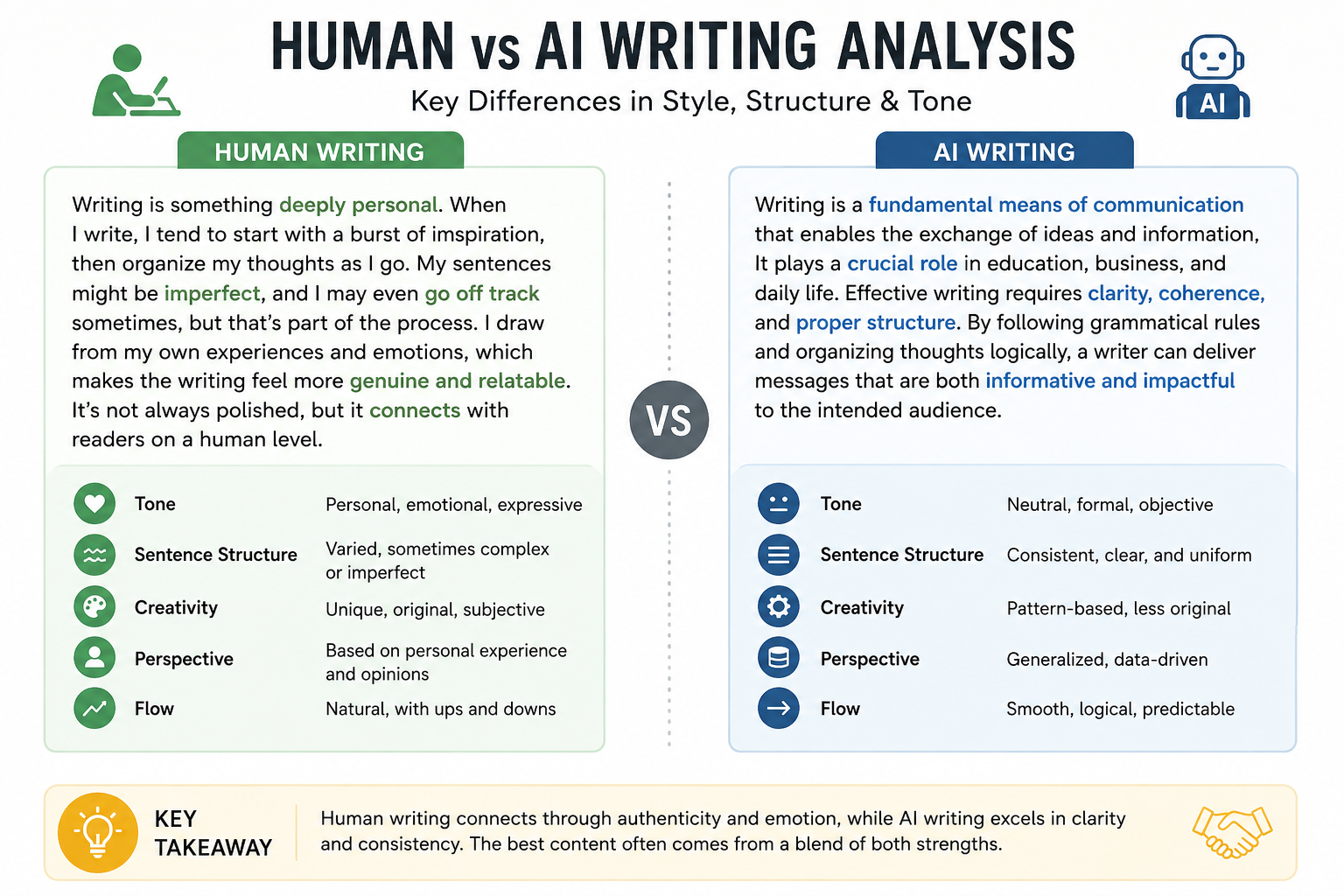
Over the last two years, GPTZero has expanded from a detection tool into a broader content verification platform.
Its flagship feature remains the AI Content Detector, but several additional tools have been added.
Core Detection Features
- AI writing detection
- Sentence-level highlighting
- Paragraph-level analysis
- Confidence scoring
- Batch document scanning
- PDF and DOCX support
Educator Tools
GPTZero has become particularly popular among schools and universities because it offers:
- Classroom integrations
- LMS compatibility
- Assignment monitoring
- Student writing reports
- Authorship verification
Chrome Extension
One of GPTZero’s strongest advantages is its browser extension, which allows users to analyze content directly on websites, Google Docs, and online platforms.
Writing Reports
GPTZero generates detailed reports showing:
- Percentage of AI-generated content
- Highlighted suspicious passages
- Writing pattern analysis
- Downloadable evidence reports
Enterprise Solutions
Organizations can access:
- API integrations
- Team management
- Workflow automation
- Bulk document analysis
- Custom reporting dashboards
The platform has become especially attractive to publishers and agencies that need to verify large volumes of content efficiently.
3. GPTZero Accuracy: Real-World Performance in 2026
Accuracy is where GPTZero truly differentiates itself from many competitors.
The company regularly publishes benchmark results claiming detection rates above 98% for modern AI models.
More importantly, many independent evaluations conducted throughout 2025 and 2026 have shown GPTZero consistently ranking among the top-performing AI detectors available.
Strengths
GPTZero performs particularly well when detecting:
- Pure ChatGPT outputs
- GPT-4 and GPT-5 generated content
- Claude-generated essays
- Long-form AI articles
- AI-assisted academic writing
In many benchmark tests, GPTZero successfully identifies obvious AI content with extremely high confidence.
False Positives
One of the most important metrics for any AI detector is the false-positive rate.
A false positive occurs when genuinely human-written text is incorrectly labeled as AI-generated.
Compared with many competing tools, GPTZero generally maintains a lower false-positive rate.
This is particularly important for:
- Students
- Journalists
- Researchers
- Professional writers
because incorrect accusations can have serious consequences.
Areas Where GPTZero Struggles
Like every AI detector, GPTZero is not perfect.
Challenges remain when analyzing:
- Heavily edited AI content
- Human-AI collaborative writing
- Very short documents
- Technical documentation
- Non-native English writing
When AI-generated text has been extensively revised by humans, detection accuracy naturally decreases.
This limitation affects every major detector currently available.
Practical Reliability
For everyday use, GPTZero generally provides reliable guidance.
Most experts recommend viewing results as:
Strong indicators rather than definitive proof.
The best practice remains combining detector results with human review and contextual evidence.
4. GPTZero vs Turnitin vs ZeroGPT

The AI detection market has become increasingly competitive.
Let’s compare the three most discussed platforms.
| Feature | GPTZero | Turnitin | ZeroGPT |
|---|---|---|---|
| Individual Access | ✅ | ❌ | ✅ |
| Educational Focus | ✅ | ✅ | ⚠️ |
| AI Detection Accuracy | Very High | Very High | Moderate–High |
| False Positive Rate | Low | Very Low | Higher |
| Free Version | ✅ | ❌ | ✅ |
| Browser Extension | ✅ | ❌ | Limited |
| API Access | ✅ | Institutional | ✅ |
| Plagiarism Detection | Limited | Strong | Strong |
| LMS Integration | Growing | Excellent | Limited |
GPTZero
Best for:
- Teachers
- Students
- Publishers
- Content reviewers
Strengths: - Strong detection accuracy
- Transparent reports
- Low false-positive rates
Turnitin
Best for:
- Universities
- Colleges
- Educational institutions
Strengths: - Deep academic integrations
- Large historical writing database
- Institutional workflows
Weaknesses: - Not available directly to most individuals
ZeroGPT
Best for:
- Casual users
- Bloggers
- Freelancers
Strengths: - Free access
- Large tool ecosystem
- Simple interface
Weaknesses: - More inconsistent results in independent testing
Conclusion: Is GPTZero Worth Using in 2026?
GPTZero has matured into one of the most capable AI content detection platforms available today. Its modern detection architecture, educator-focused design, transparent reporting system, and strong real-world accuracy make it a leading choice for individuals and organizations seeking reliable AI detection.
While no detector can guarantee perfect results—especially as AI models continue to improve—GPTZero consistently performs better than many alternatives when balancing detection accuracy and false-positive risk.
For educators, publishers, content teams, and students who need trustworthy AI detection without institutional barriers, GPTZero remains one of the strongest options available in 2026.
Final Verdict
Rating: 9.2 / 10
✅ Excellent detection accuracy
✅ Strong transparency and reporting
✅ Low false-positive rates
✅ Useful browser and classroom integrations
⚠️ Less effective on heavily human-edited AI content
⚠️ Premium features required for advanced workflows
If you’re looking for a dependable AI detector that combines accessibility with professional-grade analysis, GPTZero is absolutely worth considering.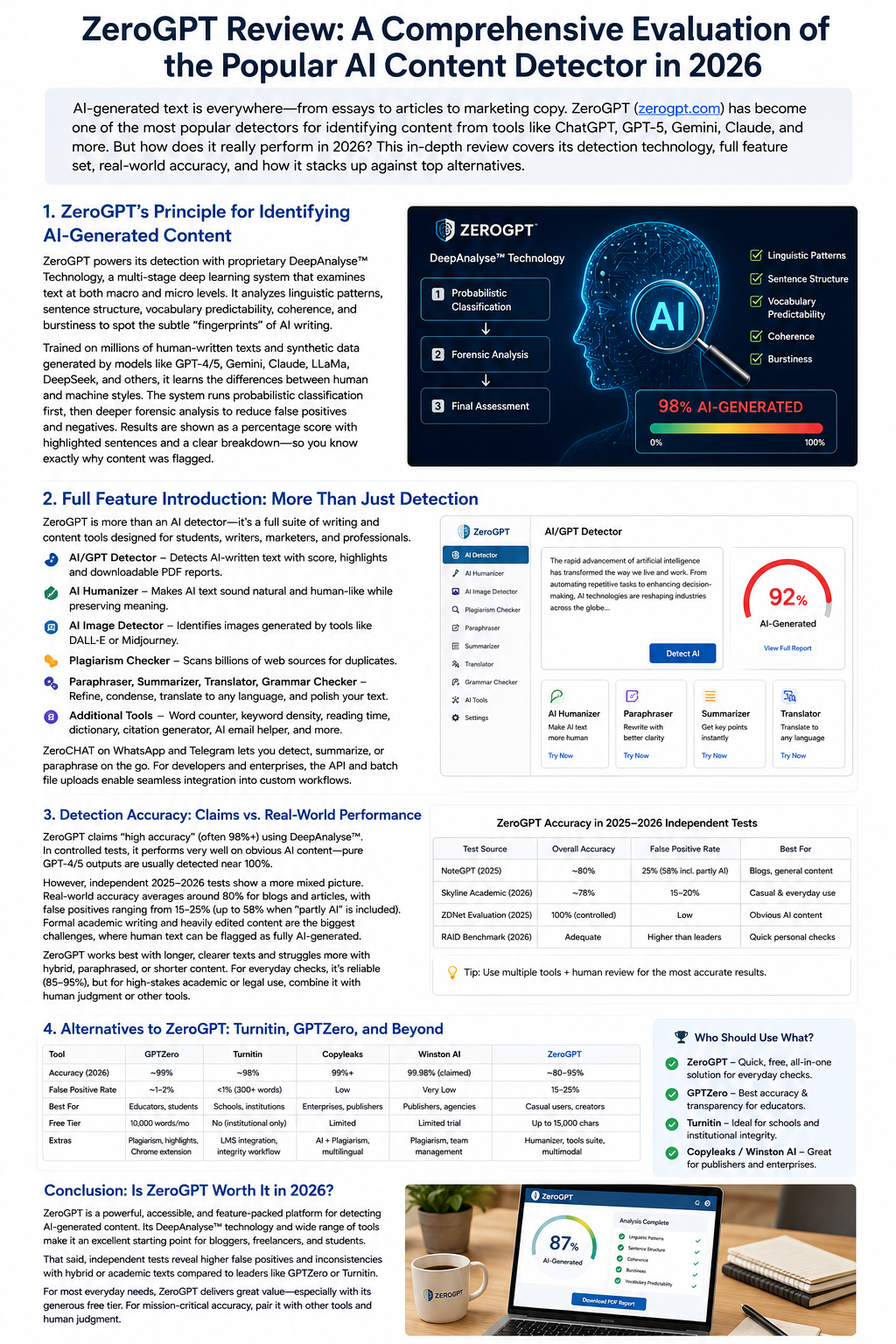
The Secret Weapon Every Student Uses During Deadline Season: How I Reduced a Turnitin AI Score from 91% to 0%
Disclaimer: AI detection systems evolve constantly, and no method can guarantee a specific score or outcome. The workflow below focuses on improving readability, originality, and authentic writing rather than attempting to “beat” any detection system. Always follow your institution’s academic integrity policies.
Turnitin Changed. The Old Tricks No Longer Work.
If you’ve recently checked a paper in Turnitin, you’ve probably noticed something frustrating.
Methods that worked a few months ago suddenly stopped working.
Why?
Because Turnitin continuously updates its AI writing detection models. As the detection algorithm evolves, many older prompting strategies and “AI bypass” techniques become much less effective.
After dozens of rounds of testing on different essays, I eventually found a workflow that consistently produced writing that was more natural, easier to read, and significantly less likely to be flagged as overly AI-like.
Here is the workflow I personally use.
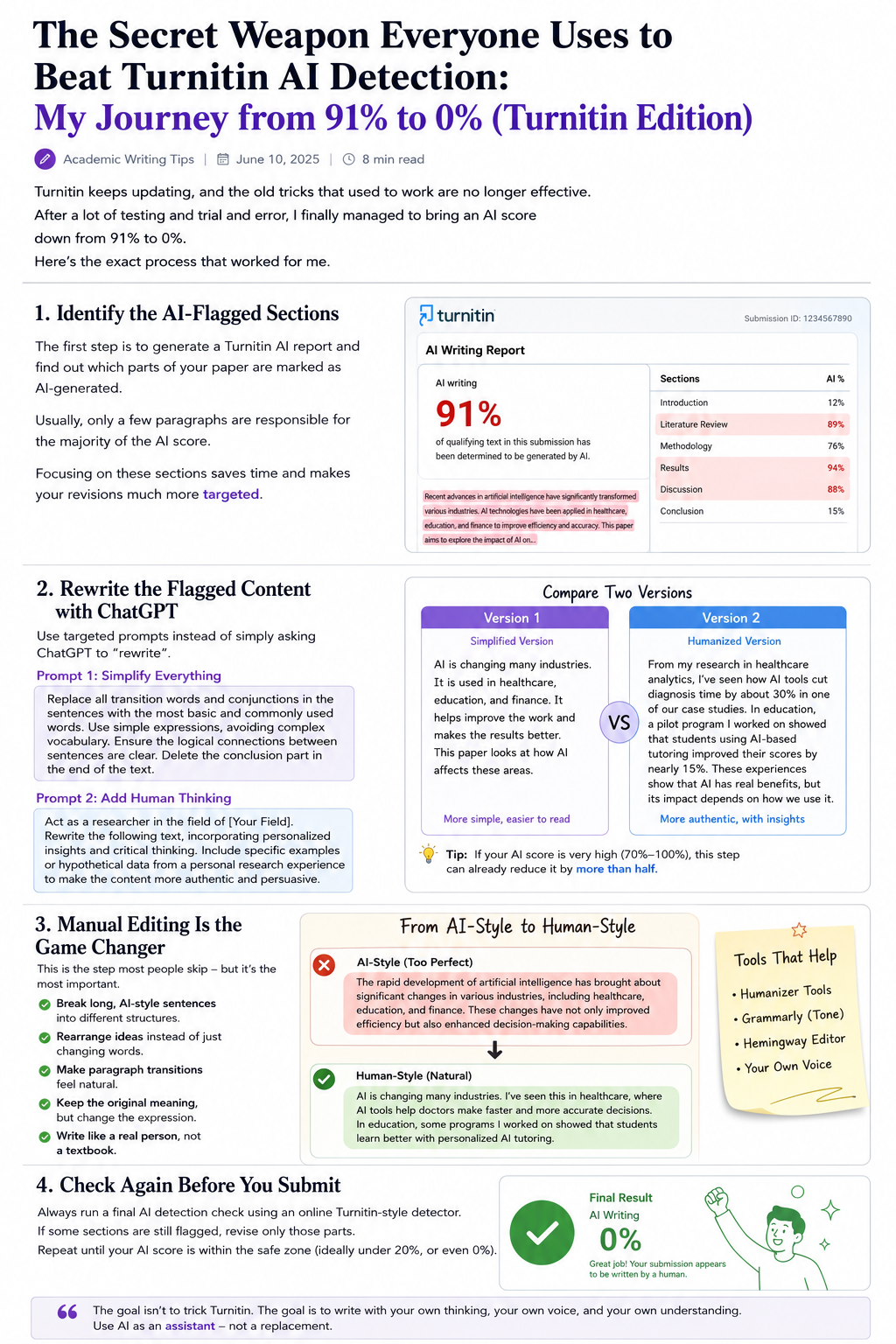
Step 1: Identify Which Sections Need Revision
Before rewriting anything, examine your Turnitin AI Writing report carefully.
Don’t immediately rewrite the entire essay.
Instead, identify the paragraphs or sections that receive the highest AI writing indication.
Usually these sections contain patterns like:
- perfectly structured paragraphs
- repetitive sentence openings
- excessive transition words
- overly formal wording
- predictable sentence rhythm
- generic conclusions
Once you’ve identified these passages, rewrite only the problematic sections first.
This saves a huge amount of time.
Step 2: Use ChatGPT to Simplify the Writing
Instead of asking ChatGPT to completely regenerate the article, ask it to simplify and normalize the language.
One prompt that works surprisingly well is:
1 | Replace all transition words and conjunctions in the sentences with the most basic and commonly used ones. Use simple expressions, avoiding complex vocabulary. Ensure the logical connections between sentences are clear. Delete the conclusion part at the end of the text. |
Why does this help?
Large language models often produce writing with:
- too many transition phrases
- polished academic wording
- repetitive paragraph patterns
- overly complete conclusions
This prompt removes many of those common characteristics and produces text that feels more straightforward.
Step 3: Add Personal Perspective
The next prompt encourages the writing to sound less generic by introducing domain-specific thinking.
1 | Act as a researcher in the field of [your field]. Rewrite the following text, incorporating personalized insights and critical thinking. Include specific examples or hypothetical data from a personal research experience to make the content more authentic and persuasive. |
This prompt helps because it introduces elements that generic AI writing often lacks:
- individual observations
- discipline-specific language
- critical analysis
- concrete examples
- realistic scenarios
Try both rewritten versions and keep whichever reads more naturally.
At this stage, many papers already become much more readable.
However, papers with very high initial AI indications often still need additional editing.
Step 4: Manual Editing Is the Most Important Part
This is the step many people skip.
Even after ChatGPT rewrites the content, the writing may still follow predictable sentence structures.
Instead of making small word substitutions, completely restructure the sentences.
A good Humanizer tool can help you:
- rewrite entire sentence structures
- vary sentence length naturally
- improve paragraph flow
- remove repetitive wording
- preserve the original meaning while making the writing sound more human
The goal isn’t simply to replace words.
The goal is to make the writing resemble how people naturally explain ideas.
Human writing usually includes: - uneven sentence lengths
- occasional informal phrasing
- varied paragraph rhythm
- smoother transitions based on ideas rather than templates
These characteristics are difficult to reproduce through simple synonym replacement alone.
Step 5: Check Again Before Submission
Before submitting your paper, run one final review.
Look for:
- repeated sentence patterns
- awkward wording
- unnatural transitions
- inconsistent tone
- formatting issues
You can also use reputable AI writing analysis tools as an additional proofreading step to identify passages that may still read as overly machine-generated.
Remember that these tools provide estimates rather than definitive judgments, and different systems may produce different results.
My Recommended Workflow
- Review the Turnitin report and identify the highlighted sections.
- Rewrite those passages using the simplification prompt.
- Generate a second version using the researcher-style prompt.
- Compare both versions and choose the clearer one.
- Manually rewrite sentence structures instead of making simple word substitutions.
- Use a Humanizer tool to improve flow and readability where appropriate.
- Proofread carefully and verify originality before submitting.
Final Thoughts
As AI writing detectors continue to evolve, relying on a single prompt or shortcut is unlikely to produce consistently good results.
The strongest approach is to treat AI as a drafting assistant rather than a replacement for your own writing process. Revising structure, adding authentic reasoning, and carefully editing for clarity will generally produce work that is both higher quality and more representative of your own voice.
Ultimately, the goal should be to submit writing that is accurate, original, and genuinely reflects your understanding of the subject.
The Secret Weapon Every Student Uses During Deadline Season: How I Reduced a Turnitin AI Score from 91% to 0%
Disclaimer: AI detection systems evolve constantly, and no method can guarantee a specific score or outcome. The workflow below focuses on improving readability, originality, and authentic writing rather than attempting to “beat” any detection system. Always follow your institution’s academic integrity policies.
Turnitin Changed. The Old Tricks No Longer Work.
If you’ve recently checked a paper in Turnitin, you’ve probably noticed something frustrating.
Methods that worked a few months ago suddenly stopped working.
Why?
Because Turnitin continuously updates its AI writing detection models. As the detection algorithm evolves, many older prompting strategies and “AI bypass” techniques become much less effective.
After dozens of rounds of testing on different essays, I eventually found a workflow that consistently produced writing that was more natural, easier to read, and significantly less likely to be flagged as overly AI-like.
Here is the workflow I personally use.
Step 1: Identify Which Sections Need Revision
Before rewriting anything, examine your Turnitin AI Writing report carefully.
Don’t immediately rewrite the entire essay.
Instead, identify the paragraphs or sections that receive the highest AI writing indication.
Usually these sections contain patterns like:
- perfectly structured paragraphs
- repetitive sentence openings
- excessive transition words
- overly formal wording
- predictable sentence rhythm
- generic conclusions
Once you’ve identified these passages, rewrite only the problematic sections first.
This saves a huge amount of time.
Step 2: Use ChatGPT to Simplify the Writing
Instead of asking ChatGPT to completely regenerate the article, ask it to simplify and normalize the language.
One prompt that works surprisingly well is:
1 | Replace all transition words and conjunctions in the sentences with the most basic and commonly used ones. Use simple expressions, avoiding complex vocabulary. Ensure the logical connections between sentences are clear. Delete the conclusion part at the end of the text. |
Why does this help?
Large language models often produce writing with:
- too many transition phrases
- polished academic wording
- repetitive paragraph patterns
- overly complete conclusions
This prompt removes many of those common characteristics and produces text that feels more straightforward.
Step 3: Add Personal Perspective
The next prompt encourages the writing to sound less generic by introducing domain-specific thinking.
1 | Act as a researcher in the field of [your field]. Rewrite the following text, incorporating personalized insights and critical thinking. Include specific examples or hypothetical data from a personal research experience to make the content more authentic and persuasive. |
This prompt helps because it introduces elements that generic AI writing often lacks:
- individual observations
- discipline-specific language
- critical analysis
- concrete examples
- realistic scenarios
Try both rewritten versions and keep whichever reads more naturally.
At this stage, many papers already become much more readable.
However, papers with very high initial AI indications often still need additional editing.
Step 4: Manual Editing Is the Most Important Part
This is the step many people skip.
Even after ChatGPT rewrites the content, the writing may still follow predictable sentence structures.
Instead of making small word substitutions, completely restructure the sentences.
A good Humanizer tool can help you:
- rewrite entire sentence structures
- vary sentence length naturally
- improve paragraph flow
- remove repetitive wording
- preserve the original meaning while making the writing sound more human
The goal isn’t simply to replace words.
The goal is to make the writing resemble how people naturally explain ideas.
Human writing usually includes: - uneven sentence lengths
- occasional informal phrasing
- varied paragraph rhythm
- smoother transitions based on ideas rather than templates
These characteristics are difficult to reproduce through simple synonym replacement alone.
Step 5: Check Again Before Submission
Before submitting your paper, run one final review.
Look for:
- repeated sentence patterns
- awkward wording
- unnatural transitions
- inconsistent tone
- formatting issues
You can also use reputable AI writing analysis tools as an additional proofreading step to identify passages that may still read as overly machine-generated.
Remember that these tools provide estimates rather than definitive judgments, and different systems may produce different results.
My Recommended Workflow
- Review the Turnitin report and identify the highlighted sections.
- Rewrite those passages using the simplification prompt.
- Generate a second version using the researcher-style prompt.
- Compare both versions and choose the clearer one.
- Manually rewrite sentence structures instead of making simple word substitutions.
- Use a Humanizer tool to improve flow and readability where appropriate.
- Proofread carefully and verify originality before submitting.
Final Thoughts
As AI writing detectors continue to evolve, relying on a single prompt or shortcut is unlikely to produce consistently good results.
The strongest approach is to treat AI as a drafting assistant rather than a replacement for your own writing process. Revising structure, adding authentic reasoning, and carefully editing for clarity will generally produce work that is both higher quality and more representative of your own voice.
Ultimately, the goal should be to submit writing that is accurate, original, and genuinely reflects your understanding of the subject.
Useful Tools
- Essay Humanizer - Make your essay sound more human-written
- AI Detector - Check if your text sounds AI-generated
- Free Citation Generator - Generate citations in multiple formats
- Math Solver - Solve math problems step by step
Turnitin AI Detection Scores Explained: 0% to 100% Breakdown
One of the most common misconceptions is that the AI percentage represents the probability that a student cheated. It doesn’t.
Instead, the percentage estimates how much of the submitted text exhibits linguistic patterns consistent with AI-generated writing.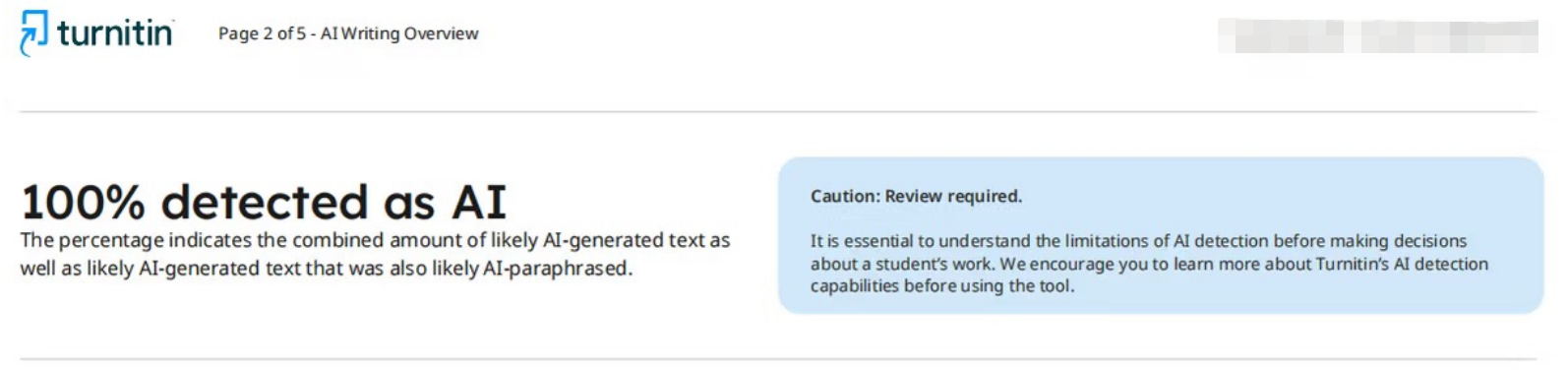
Here’s a practical interpretation of the score ranges.
| AI Score | What It Generally Means |
|---|---|
| 0% | No AI-generated writing was detected with sufficient confidence. Entirely human-written or below detection threshold. |
| 1–20% | Very little text resembles AI writing. This often occurs naturally because common phrases, definitions, or formulaic language appear in many academic papers. |
| 21–40% | Some passages display AI-like characteristics. This is not unusual for well-structured academic writing and should be reviewed rather than assumed to be AI-generated. |
| 41–60% | A noticeable portion of the document contains language patterns associated with AI writing. Human review becomes increasingly important. |
| 61–80% | A substantial amount of the text is predicted to resemble AI-generated writing. Additional context and evidence should be considered before drawing conclusions. |
| 81–100% | Most of the document demonstrates characteristics commonly associated with AI-generated content. Even so, this is not definitive proof that AI was used. |
What Turnitin’s AI Writing Percentage Measures
Turnitin’s AI writing indicator focuses on text characteristics, not user behavior.
Specifically, it analyzes features such as:
- Sentence predictability
- Linguistic consistency
- Vocabulary distribution
- Writing rhythm
- Structural repetition
- Statistical language patterns
Large language models like ChatGPT tend to produce highly fluent and statistically predictable text. Turnitin’s detector attempts to recognize these patterns across longer passages.
Importantly, the percentage does not measure intent.
A student who used AI extensively and carefully revised the output may receive a relatively low score, while an experienced academic writer producing highly formal prose could receive a higher score than expected.
The indicator therefore reflects text similarity to AI-generated language, not actual AI usage.
What the AI Percentage Is Not
Understanding what the score doesn’t represent is just as important.
The AI percentage is not:
- A plagiarism score
- A certainty score
- Proof that AI tools were used
- A disciplinary recommendation
- A measure of academic integrity
- Evidence of intentional misconduct
For example, a paper showing 70% AI writing is not saying there is a 70% chance the student used ChatGPT.
Likewise, a 0% score does not guarantee that AI was never involved. It simply means the submitted text did not exhibit enough detectable AI writing patterns.
Think of the indicator as a screening tool, similar to plagiarism matching. It highlights content that deserves closer review rather than delivering a final verdict.
How Turnitin’s AI Indicator Works (High-Level)
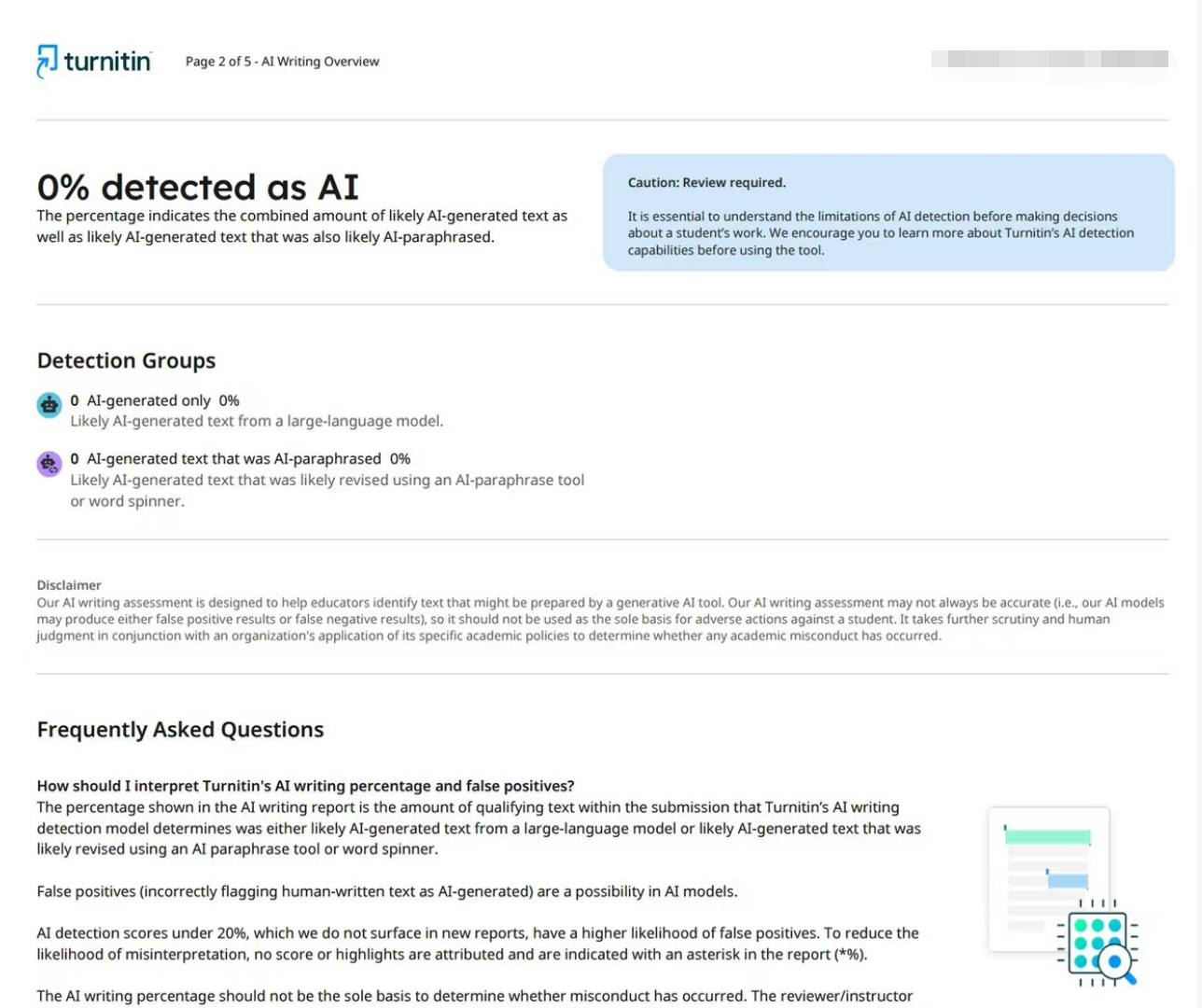
Turnitin has not publicly disclosed its complete detection algorithms, but its overall approach can be understood at a high level.
Rather than searching for specific AI-generated phrases, the system evaluates statistical characteristics across larger sections of text.
The process generally involves:
- Breaking the submission into analyzable text segments.
- Examining linguistic and statistical writing patterns.
- Comparing those patterns with characteristics commonly observed in AI-generated writing.
- Calculating an overall percentage of text that appears consistent with those patterns.
The system is designed to reduce false positives by avoiding conclusions based on isolated sentences. Instead, it evaluates writing across longer passages where AI-generated patterns become more statistically meaningful.
This explains why very short assignments or documents containing limited original writing may not receive an AI score at all.
Practical Guidance for Educators
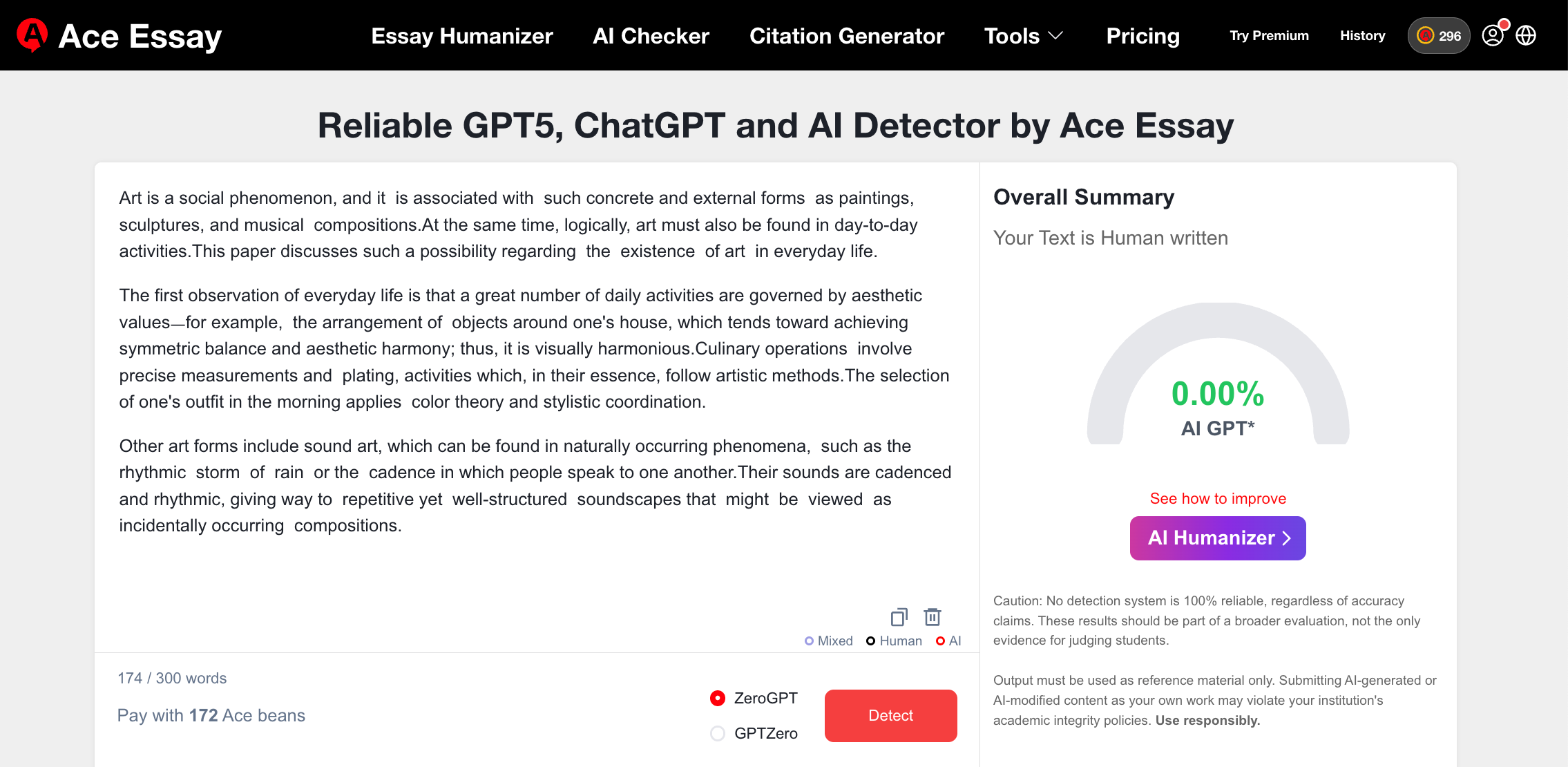
Try it now!
The most effective way to use Turnitin’s AI indicator is as one piece of a broader academic integrity review.
Rather than focusing solely on the percentage, educators should consider additional evidence, including:
- The student’s previous writing style
- Draft history and revision records
- Writing process documentation
- In-class writing samples
- Source citations and references
- Opportunities for the student to explain their work
A high AI score should begin a conversation—not end one.
Similarly, a low score should not automatically eliminate concerns if other evidence suggests inappropriate AI assistance.
Ultimately, academic integrity decisions are strongest when they combine technology with professional judgment. AI detection tools provide valuable insights, but they work best when interpreted alongside context, evidence, and educator expertise.
Final Thoughts
Turnitin’s AI Detection Score is best understood as a risk indicator rather than a verdict. It estimates how much of a document resembles AI-generated writing based on linguistic patterns, but it cannot determine authorship, intent, or academic honesty on its own.
Whether the score is 0% or 100%, the number should always be interpreted carefully and in context. By understanding what the AI percentage measures—and what it does not—educators can make more informed, fair, and balanced decisions while supporting responsible use of AI in education.
WTF: 100% Detected as AI! One Cup of Coffee to Solve TurnitinDetect
The Nightmare: Your AI Essay Just Got Flagged
Picture this: You’ve spent hours crafting what you thought was the perfect essay. You ran it through Turnitin just to check, and boom—100% AI DETECTED. Your heart sinks. Your professor sees that red flag. And your deadline? Still tomorrow.
Sound familiar? You’re not alone.
Essay Writing Outline Guidance (Without Losing Your Mind)
Let’s be real—writing a solid essay doesn’t have to feel like climbing Mount Everest. Here’s a battle-tested outline that actually works:
- Hook ‘Em – Start with a killer introduction that makes your reader curious
- Thesis Statement – One clear sentence that sums up your entire argument
- Body Paragraphs – Each with a topic sentence, evidence, and analysis
- Counter-Arguments – Address the opposition (shows you’re smart!)
- Conclusion – Tie it all together with a bow
The key? Structure your thoughts before you write. Spend 10 minutes on an outline, save yourself hours of rewrites. According to Turnitin’s latest research, students who use structured outlines have significantly fewer issues with AI detection because the writing flows more naturally from genuine critical thinking.
The Brutal Truth About AI-Generated Essays
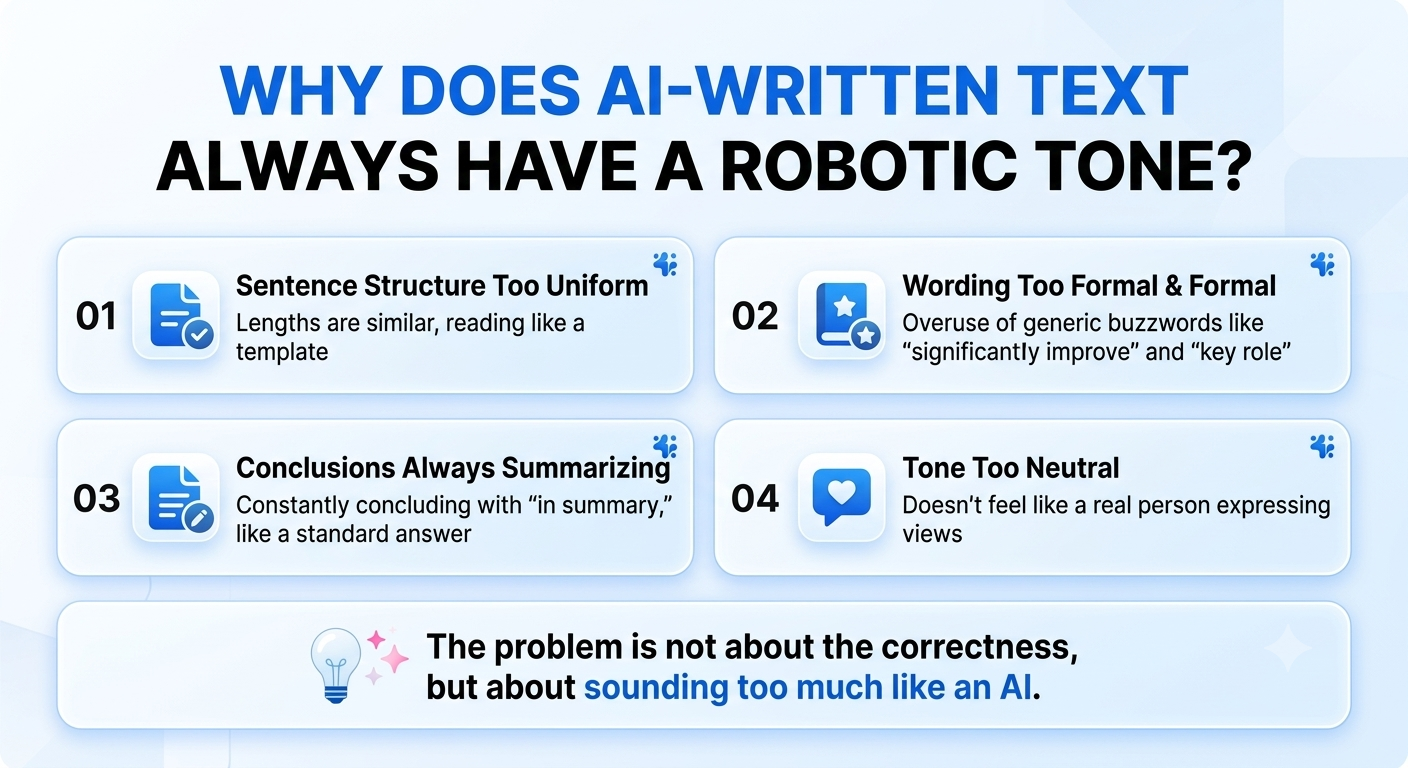
Okay, let’s talk about the elephant in the room. AI writing has a tell.
By October 2025, approximately 15% of essay submissions processed by Turnitin contained more than 80% AI-generated writing—and the detection tools are getting scary good at spotting it.
Here’s what makes AI essays give themselves away:
🔴 The “Too Perfect” Problem
AI writing is grammatically flawless. Every sentence structure is pristine. Every word choice is optimized. And that’s exactly the problem—real human writing has rhythm, personality, and yes, occasional imperfections.
🔴Too Neat Formatting
AI tends to produce text with:
- Perfectly balanced paragraphs
- Identical sentence lengths
- Predictable transitions (“Furthermore,” “Moreover,” “In conclusion”)
- Generic academic phrasing
🔴Lacks Deep Analysis
AI can regurgitate information, but it struggles with genuine critical thinking. Your professor wants to see your voice, your interpretation, your unique take on the topic.
Your Secret Weapon—Humanize AI & Beat TurnitinDetect ☕
What if we told you there’s a better way?
Introducing our Humanize Tool—designed specifically for students who are racing against deadlines. Here’s the magic: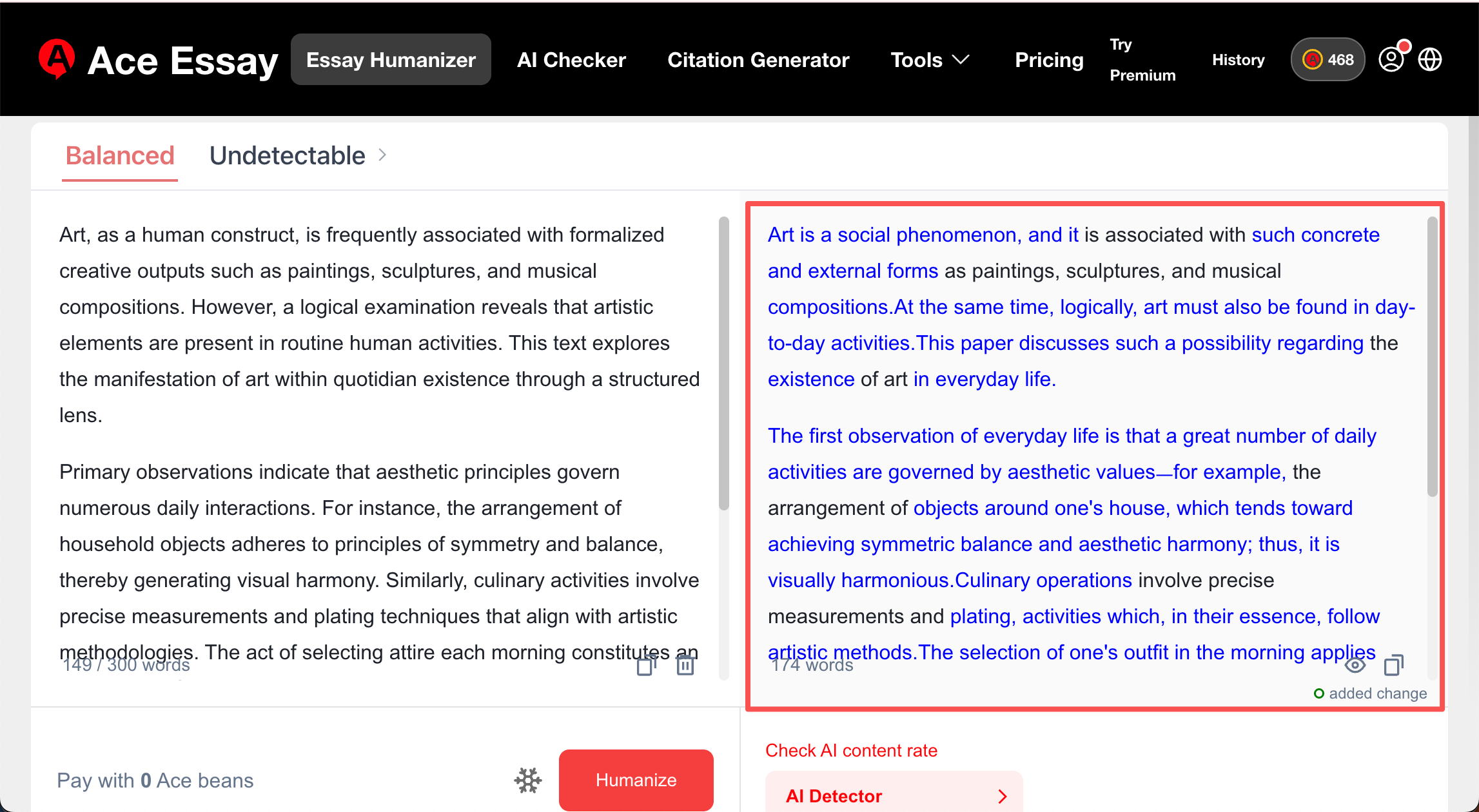
✨ What Our Tool Does:
- Rewrites AI-generated content to sound more natural and human
- Varies sentence structures to match authentic writing patterns
- Adds personality without losing your core message
- Maintains academic quality while reducing the “AI fingerprint”
🛠️ Built-In Turnitin Detection Check
Here’s the best part: We included Turnitin detection functionality right in our tool.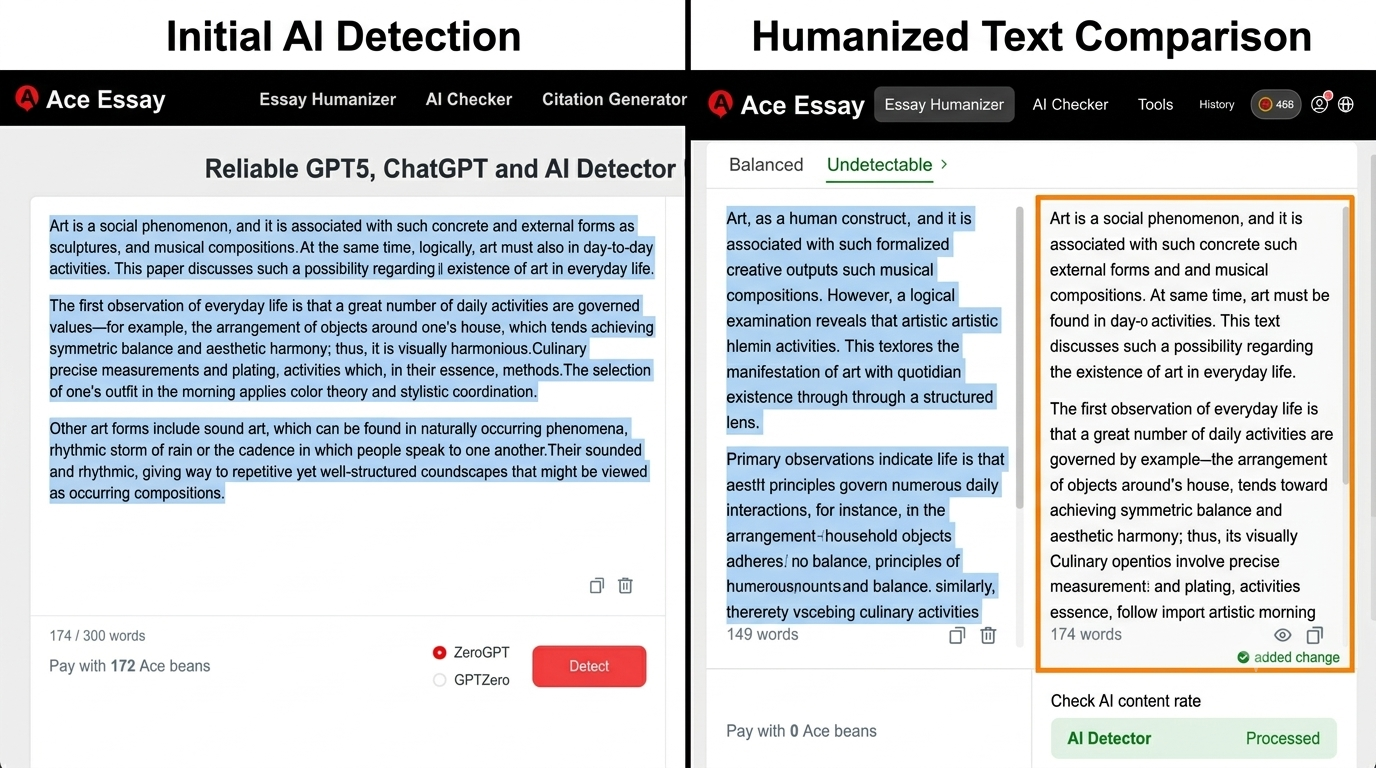
You can:
- Paste your AI-generated essay
- Run the humanization process
- Instantly check if it still flags as AI before you submit
- Adjust and refine until you’re in the clear
It’s like having a coffee break while your essay gets humanized. One cup of coffee (or tea—no judgment) later, you’re ready to submit with confidence.
Why This Matters
Let’s be honest: sometimes you need help getting started. Sometimes the blank page is paralyzing. Our tool isn’t about cheating—it’s about polishing your work to meet academic standards while keeping your authentic voice front and center.
Final Thoughts: Work Smarter, Not Harder
The academic world is evolving. AI detection tools like Turnitin are here to stay, and they’re getting more sophisticated by the day. But so are the tools that help you present your best work.
Remember:
- Use AI as a starting point, not the final product
- Always add your own voice and analysis
- Let our Humanize tool handle the technical “AI smell”
- Submit with confidence before that deadline hits
Ready to Try It?
Don’t let AI detection anxiety ruin your night. Grab your coffee, humanize your essay, and crush that deadline.
Your future self will thank you. 🎓
Turnitin and Humanizer: The Battle Between AI Detection and Evasion Tools
Introduction
The academic landscape has been fundamentally transformed by artificial intelligence. As AI writing tools like ChatGPT, Gemini, and other large language models become increasingly sophisticated, educational institutions face unprecedented challenges in maintaining academic integrity. At the center of this technological tug-of-war stands Turnitin—the industry-standard plagiarism detection software—and a new generation of tools known as “humanizers” designed to bypass AI detection systems. This article explores the complex relationship between these technologies, the ethical implications, and what it means for the future of academic honesty.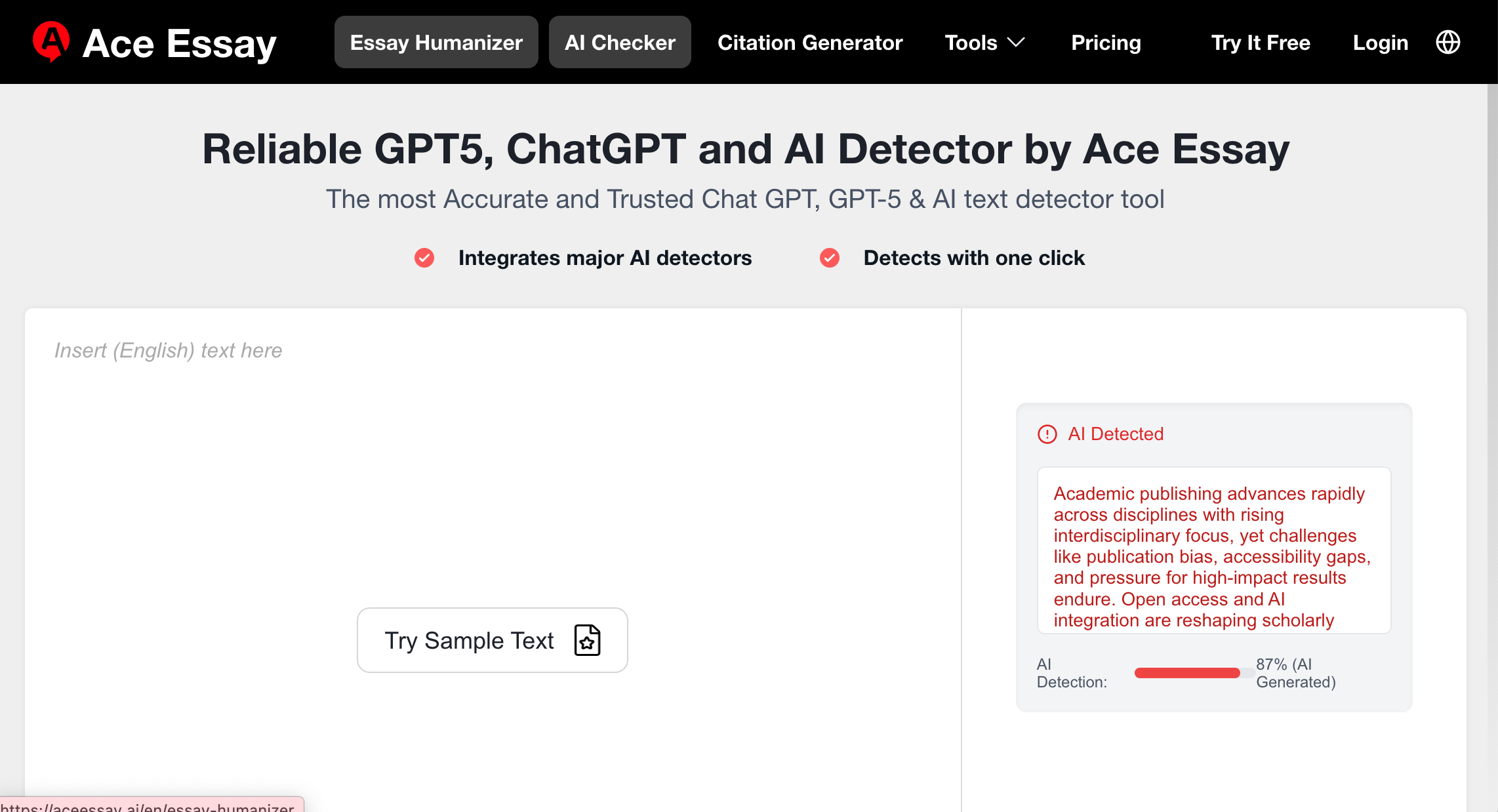
Understanding Turnitin’s AI Detection Capabilities
Turnitin has evolved far beyond its original purpose of detecting copied text. In response to the surge of AI-generated content, the platform developed sophisticated AI detection capabilities that analyze writing patterns to identify machine-produced text.
According to Turnitin’s official resources, their AI writing detection tool is designed to “ensure academic integrity” by identifying content generated by AI systems. The technology examines various linguistic features, including sentence structure variability, word choice patterns, and writing flow characteristics that typically differ between human and AI-generated content.
In August 2024, Turnitin announced significant expansions to its offerings, including AI-powered grading tools and enhanced classroom digitization solutions. These updates reflect the platform’s commitment to adapting to the rapidly changing educational technology landscape.
However, Turnitin’s AI detector hasn’t been without controversy. Reports indicate that the platform updated its AI detector after widespread student and faculty concerns over false positives, opaque scoring methods, and equity issues. The update focused on implementing stricter confidence thresholds and providing clearer reporting to address these valid concerns.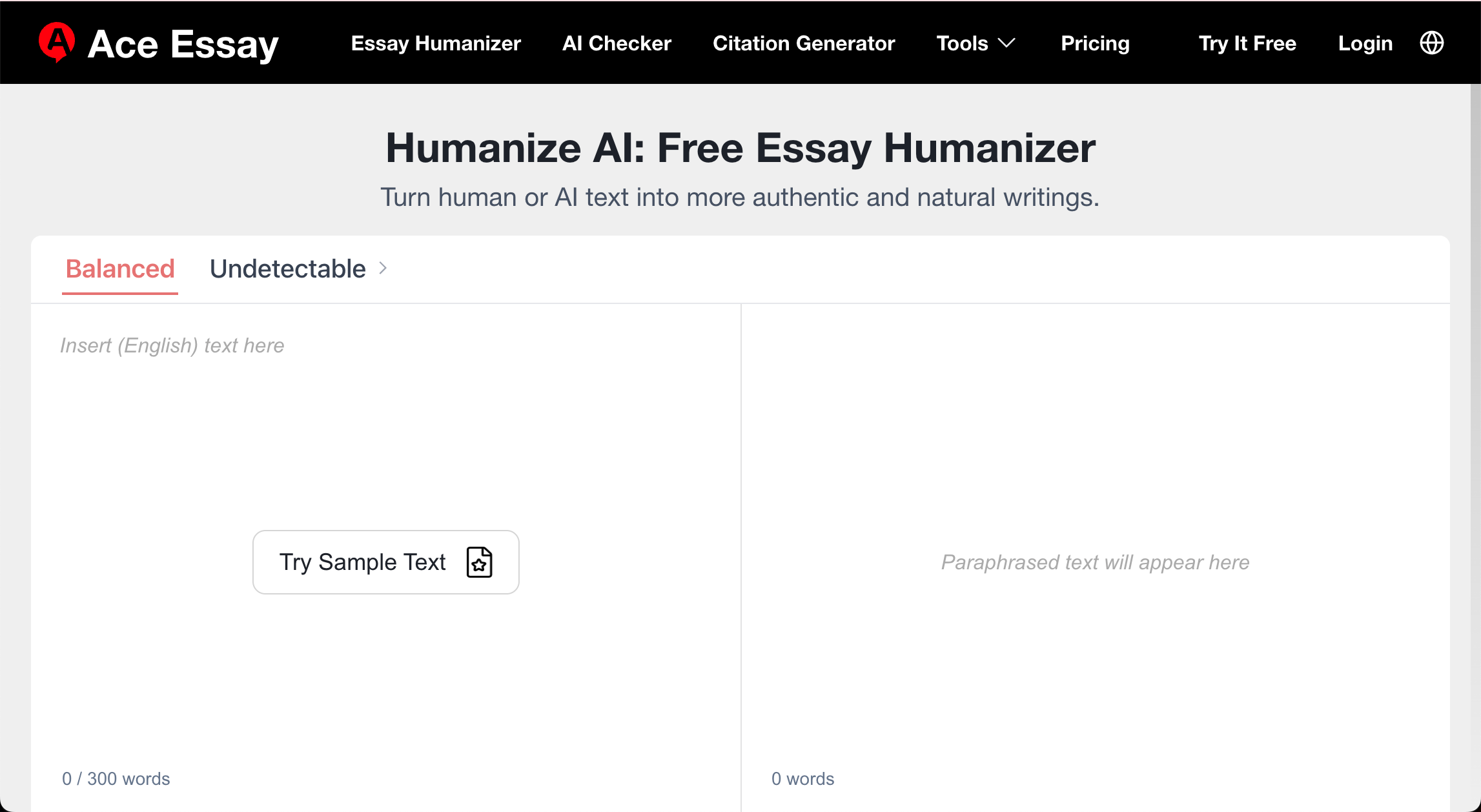
The Rise of AI Humanizer Tools
In direct response to AI detection technology, a new market has emerged: AI humanizer tools. These services claim to transform AI-generated content into text that bypasses detection systems, essentially “humanizing” machine-produced writing.
Websites like HumanizeAI.io and Humanize.ai offer free online tools that promise to convert AI-generated content into “human-like, engaging text.” These platforms typically use advanced paraphrasing techniques that modify sentence structures, alter word choices, and introduce subtle imperfections meant to mimic natural human writing patterns.
According to one analysis, tools like GPTinf and similar humanizers have achieved reported human-likeness scores of 95-98% on various detection platforms. Some humanizers even market specific features like “bypass Turnitin” modes, directly targeting educational integrity systems.
The technology behind these tools goes far beyond simple paraphrasing. As noted by Humanize AI’s marketing, these services understand “sentence rhythm, word choice patterns, and subtle imperfections that make writing actually feel human”—a concerning development for academic institutions.
The Ethical and Practical Implications
Student Concerns and False Positives
Perhaps the most troubling aspect of this technological arms race is the impact on legitimate students. Research has shown that Turnitin’s AI detection has falsely flagged legitimate student work, raising serious questions about the reliability of these systems.
A recent report by the UK’s Office of the Independent Adjudicator (OIA) documented cases where university sanctions were overturned after students were wrongly accused of using AI-generated content. Vanderbilt University went so far as to disable Turnitin’s AI detector entirely in August 2023 after months of testing revealed significant reliability issues.
Some students have been affected more than others. Research indicates that non-native English speakers and students who write in a more structured, formal style are disproportionately flagged by AI detection tools—a troubling equity concern that undermines the fairness of these systems.
Academic Integrity at Stake
The existence of humanizer tools fundamentally challenges the concept of academic integrity. When students can easily circumvent detection systems, the educational value of writing assignments becomes questionable. The purpose of academic writing—to develop critical thinking, research skills, and the ability to articulate ideas—becomes hollow when the actual writing can be outsourced to machines.
Educational institutions face a difficult balancing act. They must:
- Adapt to new technologies without completely prohibiting AI assistance
- Maintain academic standards while recognizing the changing nature of writing
- Protect legitimate students from false accusations
- Develop fair assessment methods that account for AI’s role in modern workflows
The Arms Race Continues
The relationship between Turnitin and humanizer tools represents a classic technological arms race. As detection methods improve, evasion techniques become more sophisticated, and vice versa. This dynamic creates an unstable environment where neither technology can provide definitive answers.
Turnitin’s approach has been to continuously update its detection models as new large language models are released. According to industry analysis, the platform’s AI detection capabilities evolve on a regular cadence to keep pace with emerging AI systems. However, humanizer tools quickly adapt to these changes, creating a seemingly endless cycle.
Some experts question whether this arms race is ultimately winnable. The fundamental challenge is that AI writing detection and AI writing generation rely on similar underlying technologies—natural language processing and machine learning—which means each side can potentially anticipate the other’s methods.
Recommendations for Students and Educators
For Students
- Understand your institution’s policies regarding AI assistance and always disclose when you’ve used AI tools
- Focus on learning rather than detection-bypassing—the skills you develop matter more than any single assignment
- If falsely accused, know your rights and be prepared to provide evidence of your writing process
- Use AI as a learning aid, not a replacement for your own intellectual contribution
For Educators
- Rethink assessment methods to focus on processes rather than final products
- Diversify evaluation criteria to include oral presentations, drafts, and collaborative work
- Stay informed about both AI capabilities and detection limitations
- Consider disabling AI detection if your institution’s experience mirrors Vanderbilt’s concerns
- Communicate clearly with students about acceptable AI use in your courses
Conclusion
The battle between Turnitin and humanizer tools represents a microcosm of larger questions about authenticity, technology, and education in the AI age. While detection tools like Turnitin continue to evolve in response to AI-generated content, humanizer tools persistently push back, creating an ongoing technological chess match with real consequences for students and educators alike.
The most prudent path forward may not be found in more sophisticated detection or evasion technologies, but in a fundamental rethinking of what academic assignments are meant to accomplish. As AI becomes increasingly integrated into professional and personal life, educational institutions must adapt their assessment methods to emphasize skills that AI cannot replicate: critical thinking, creativity, emotional intelligence, and authentic human connection.
Until then, the arms race between Turnitin and humanizers will continue—a race that ultimately serves neither educational excellence nor genuine academic integrity. The question is not whether we can detect AI-written content, but whether we can cultivate the intellectual growth that makes such detection necessary.
Key Takeaways:
- Turnitin’s AI detection has faced criticism for false positives and equity issues
- Humanizer tools claim to bypass detection with high success rates
- Both technologies are engaged in an ongoing arms race
- The ethical implications extend far beyond simple detection vs. evasion
- The ultimate solution may require reimagining academic assessment rather than improving detection
Turnitin and Humanizer: The Battle Between AI Detection and Evasion Tools
Introduction
The academic landscape has been fundamentally transformed by artificial intelligence. As AI writing tools like ChatGPT, Gemini, and other large language models become increasingly sophisticated, educational institutions face unprecedented challenges in maintaining academic integrity. At the center of this technological tug-of-war stands Turnitin—the industry-standard plagiarism detection software—and a new generation of tools known as “humanizers” designed to bypass AI detection systems. This article explores the complex relationship between these technologies, the ethical implications, and what it means for the future of academic honesty.
Understanding Turnitin’s AI Detection Capabilities
Turnitin has evolved far beyond its original purpose of detecting copied text. In response to the surge of AI-generated content, the platform developed sophisticated AI detection capabilities that analyze writing patterns to identify machine-produced text.
According to Turnitin’s official resources, their AI writing detection tool is designed to “ensure academic integrity” by identifying content generated by AI systems. The technology examines various linguistic features, including sentence structure variability, word choice patterns, and writing flow characteristics that typically differ between human and AI-generated content.
In August 2024, Turnitin announced significant expansions to its offerings, including AI-powered grading tools and enhanced classroom digitization solutions. These updates reflect the platform’s commitment to adapting to the rapidly changing educational technology landscape.
However, Turnitin’s AI detector hasn’t been without controversy. Reports indicate that the platform updated its AI detector after widespread student and faculty concerns over false positives, opaque scoring methods, and equity issues. The update focused on implementing stricter confidence thresholds and providing clearer reporting to address these valid concerns.
The Rise of AI Humanizer Tools
In direct response to AI detection technology, a new market has emerged: AI humanizer tools. These services claim to transform AI-generated content into text that bypasses detection systems, essentially “humanizing” machine-produced writing.
Websites like HumanizeAI.io and Humanize.ai offer free online tools that promise to convert AI-generated content into “human-like, engaging text.” These platforms typically use advanced paraphrasing techniques that modify sentence structures, alter word choices, and introduce subtle imperfections meant to mimic natural human writing patterns.
According to one analysis, tools like GPTinf and similar humanizers have achieved reported human-likeness scores of 95-98% on various detection platforms. Some humanizers even market specific features like “bypass Turnitin” modes, directly targeting educational integrity systems.
The technology behind these tools goes far beyond simple paraphrasing. As noted by Humanize AI’s marketing, these services understand “sentence rhythm, word choice patterns, and subtle imperfections that make writing actually feel human”—a concerning development for academic institutions.
The Ethical and Practical Implications
Student Concerns and False Positives
Perhaps the most troubling aspect of this technological arms race is the impact on legitimate students. Research has shown that Turnitin’s AI detection has falsely flagged legitimate student work, raising serious questions about the reliability of these systems.
A recent report by the UK’s Office of the Independent Adjudicator (OIA) documented cases where university sanctions were overturned after students were wrongly accused of using AI-generated content. Vanderbilt University went so far as to disable Turnitin’s AI detector entirely in August 2023 after months of testing revealed significant reliability issues.
Some students have been affected more than others. Research indicates that non-native English speakers and students who write in a more structured, formal style are disproportionately flagged by AI detection tools—a troubling equity concern that undermines the fairness of these systems.
Academic Integrity at Stake
The existence of humanizer tools fundamentally challenges the concept of academic integrity. When students can easily circumvent detection systems, the educational value of writing assignments becomes questionable. The purpose of academic writing—to develop critical thinking, research skills, and the ability to articulate ideas—becomes hollow when the actual writing can be outsourced to machines.
Educational institutions face a difficult balancing act. They must:
- Adapt to new technologies without completely prohibiting AI assistance
- Maintain academic standards while recognizing the changing nature of writing
- Protect legitimate students from false accusations
- Develop fair assessment methods that account for AI’s role in modern workflows
The Arms Race Continues
The relationship between Turnitin and humanizer tools represents a classic technological arms race. As detection methods improve, evasion techniques become more sophisticated, and vice versa. This dynamic creates an unstable environment where neither technology can provide definitive answers.
Turnitin’s approach has been to continuously update its detection models as new large language models are released. According to industry analysis, the platform’s AI detection capabilities evolve on a regular cadence to keep pace with emerging AI systems. However, humanizer tools quickly adapt to these changes, creating a seemingly endless cycle.
Some experts question whether this arms race is ultimately winnable. The fundamental challenge is that AI writing detection and AI writing generation rely on similar underlying technologies—natural language processing and machine learning—which means each side can potentially anticipate the other’s methods.
Recommendations for Students and Educators
For Students
- Understand your institution’s policies regarding AI assistance and always disclose when you’ve used AI tools
- Focus on learning rather than detection-bypassing—the skills you develop matter more than any single assignment
- If falsely accused, know your rights and be prepared to provide evidence of your writing process
- Use AI as a learning aid, not a replacement for your own intellectual contribution
For Educators
- Rethink assessment methods to focus on processes rather than final products
- Diversify evaluation criteria to include oral presentations, drafts, and collaborative work
- Stay informed about both AI capabilities and detection limitations
- Consider disabling AI detection if your institution’s experience mirrors Vanderbilt’s concerns
- Communicate clearly with students about acceptable AI use in your courses
Conclusion
The battle between Turnitin and humanizer tools represents a microcosm of larger questions about authenticity, technology, and education in the AI age. While detection tools like Turnitin continue to evolve in response to AI-generated content, humanizer tools persistently push back, creating an ongoing technological chess match with real consequences for students and educators alike.
The most prudent path forward may not be found in more sophisticated detection or evasion technologies, but in a fundamental rethinking of what academic assignments are meant to accomplish. As AI becomes increasingly integrated into professional and personal life, educational institutions must adapt their assessment methods to emphasize skills that AI cannot replicate: critical thinking, creativity, emotional intelligence, and authentic human connection.
Until then, the arms race between Turnitin and humanizers will continue—a race that ultimately serves neither educational excellence nor genuine academic integrity. The question is not whether we can detect AI-written content, but whether we can cultivate the intellectual growth that makes such detection necessary.
Key Takeaways:
- Turnitin’s AI detection has faced criticism for false positives and equity issues
- Humanizer tools claim to bypass detection with high success rates
- Both technologies are engaged in an ongoing arms race
- The ethical implications extend far beyond simple detection vs. evasion
- The ultimate solution may require reimagining academic assessment rather than improving detection