The Secret Weapon Every Student Uses During Deadline Season: How I Reduced a Turnitin AI Score from 91% to 0%
Disclaimer: AI detection systems evolve constantly, and no method can guarantee a specific score or outcome. The workflow below focuses on improving readability, originality, and authentic writing rather than attempting to “beat” any detection system. Always follow your institution’s academic integrity policies.
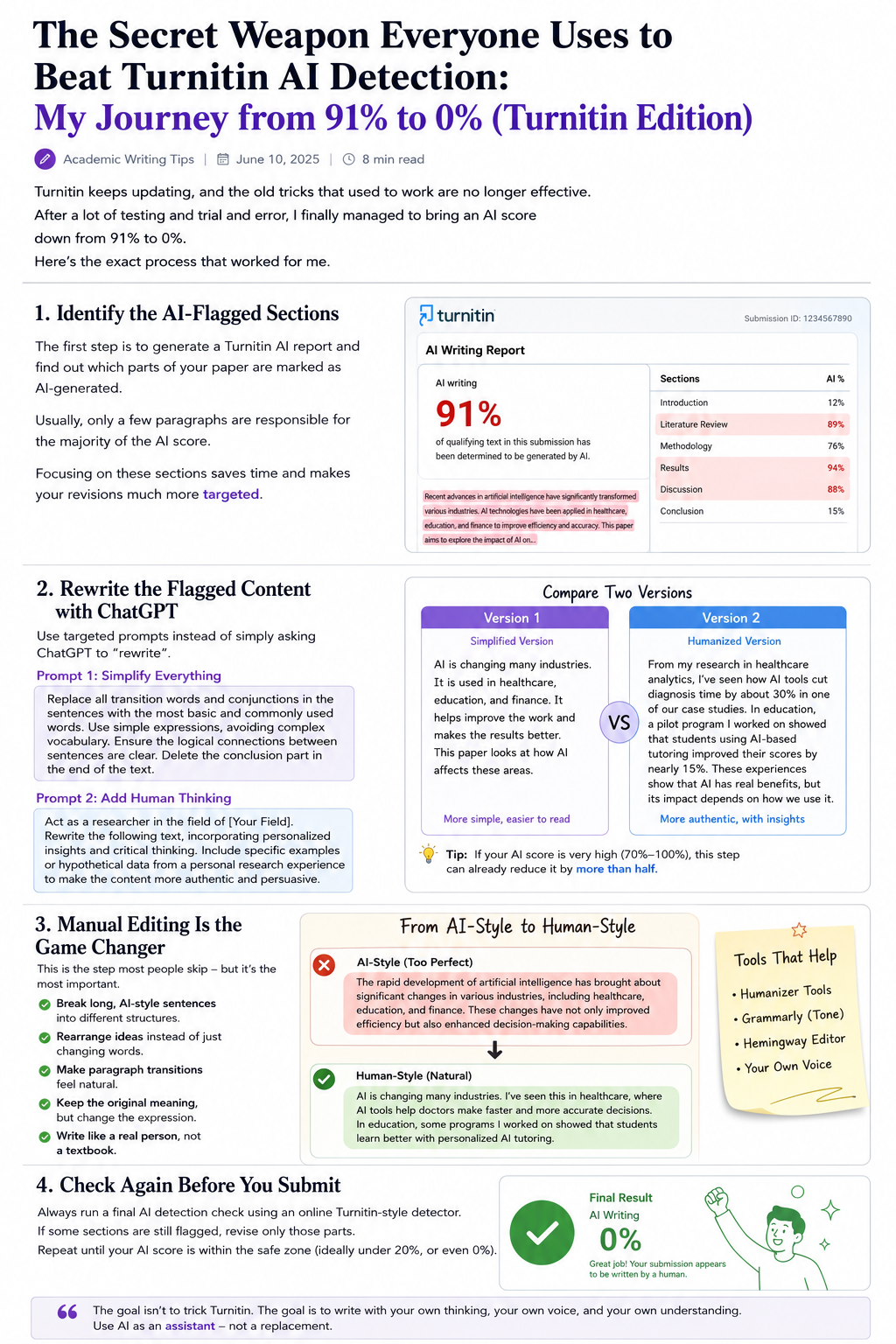
Turnitin Changed. The Old Tricks No Longer Work.
If you’ve recently checked a paper in Turnitin, you’ve probably noticed something frustrating.
Methods that worked a few months ago suddenly stopped working.
Why?
Because Turnitin continuously updates its AI writing detection models. As the detection algorithm evolves, many older prompting strategies and “AI bypass” techniques become much less effective.
After dozens of rounds of testing on different essays, I eventually found a workflow that consistently produced writing that was more natural, easier to read, and significantly less likely to be flagged as overly AI-like.
Here is the workflow I personally use.
Step 1: Identify Which Sections Need Revision
Before rewriting anything, examine your Turnitin AI Writing report carefully.
Don’t immediately rewrite the entire essay.
Instead, identify the paragraphs or sections that receive the highest AI writing indication.
Usually these sections contain patterns like:
- perfectly structured paragraphs
- repetitive sentence openings
- excessive transition words
- overly formal wording
- predictable sentence rhythm
- generic conclusions
Once you’ve identified these passages, rewrite only the problematic sections first.
This saves a huge amount of time.
Step 2: Use ChatGPT to Simplify the Writing
Instead of asking ChatGPT to completely regenerate the article, ask it to simplify and normalize the language.
One prompt that works surprisingly well is:
1 | Replace all transition words and conjunctions in the sentences with the most basic and commonly used ones. Use simple expressions, avoiding complex vocabulary. Ensure the logical connections between sentences are clear. Delete the conclusion part at the end of the text. |
Why does this help?
Large language models often produce writing with:
- too many transition phrases
- polished academic wording
- repetitive paragraph patterns
- overly complete conclusions
This prompt removes many of those common characteristics and produces text that feels more straightforward.
Step 3: Add Personal Perspective
The next prompt encourages the writing to sound less generic by introducing domain-specific thinking.
1 | Act as a researcher in the field of [your field]. Rewrite the following text, incorporating personalized insights and critical thinking. Include specific examples or hypothetical data from a personal research experience to make the content more authentic and persuasive. |
This prompt helps because it introduces elements that generic AI writing often lacks:
- individual observations
- discipline-specific language
- critical analysis
- concrete examples
- realistic scenarios
Try both rewritten versions and keep whichever reads more naturally.
At this stage, many papers already become much more readable.
However, papers with very high initial AI indications often still need additional editing.
Step 4: Manual Editing Is the Most Important Part
This is the step many people skip.
Even after ChatGPT rewrites the content, the writing may still follow predictable sentence structures.
Instead of making small word substitutions, completely restructure the sentences.
A good Humanizer tool can help you:
- rewrite entire sentence structures
- vary sentence length naturally
- improve paragraph flow
- remove repetitive wording
- preserve the original meaning while making the writing sound more human
The goal isn’t simply to replace words.
The goal is to make the writing resemble how people naturally explain ideas.
Human writing usually includes: - uneven sentence lengths
- occasional informal phrasing
- varied paragraph rhythm
- smoother transitions based on ideas rather than templates
These characteristics are difficult to reproduce through simple synonym replacement alone.
Step 5: Check Again Before Submission
Before submitting your paper, run one final review.
Look for:
- repeated sentence patterns
- awkward wording
- unnatural transitions
- inconsistent tone
- formatting issues
You can also use reputable AI writing analysis tools as an additional proofreading step to identify passages that may still read as overly machine-generated.
Remember that these tools provide estimates rather than definitive judgments, and different systems may produce different results.
My Recommended Workflow
- Review the Turnitin report and identify the highlighted sections.
- Rewrite those passages using the simplification prompt.
- Generate a second version using the researcher-style prompt.
- Compare both versions and choose the clearer one.
- Manually rewrite sentence structures instead of making simple word substitutions.
- Use a Humanizer tool to improve flow and readability where appropriate.
- Proofread carefully and verify originality before submitting.
Final Thoughts
As AI writing detectors continue to evolve, relying on a single prompt or shortcut is unlikely to produce consistently good results.
The strongest approach is to treat AI as a drafting assistant rather than a replacement for your own writing process. Revising structure, adding authentic reasoning, and carefully editing for clarity will generally produce work that is both higher quality and more representative of your own voice.
Ultimately, the goal should be to submit writing that is accurate, original, and genuinely reflects your understanding of the subject.
Useful Tools
- Essay Humanizer - Make your essay sound more human-written
- AI Detector - Check if your text sounds AI-generated
- Free Citation Generator - Generate citations in multiple formats
- Math Solver - Solve math problems step by step