Turnitin AI Detection Scores Explained: 0% to 100% Breakdown
One of the most common misconceptions is that the AI percentage represents the probability that a student cheated. It doesn’t.
Instead, the percentage estimates how much of the submitted text exhibits linguistic patterns consistent with AI-generated writing.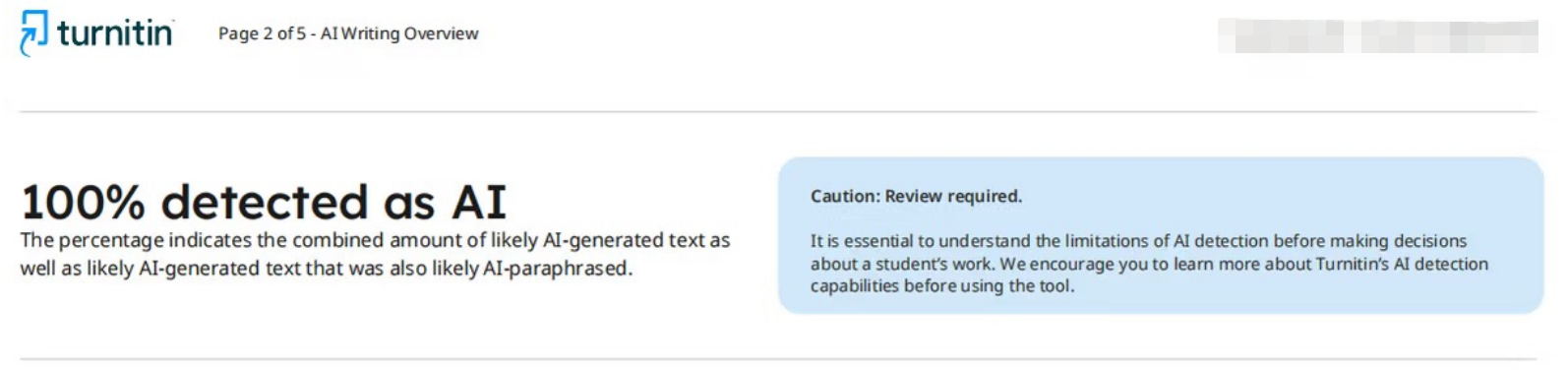
Here’s a practical interpretation of the score ranges.
| AI Score | What It Generally Means |
|---|---|
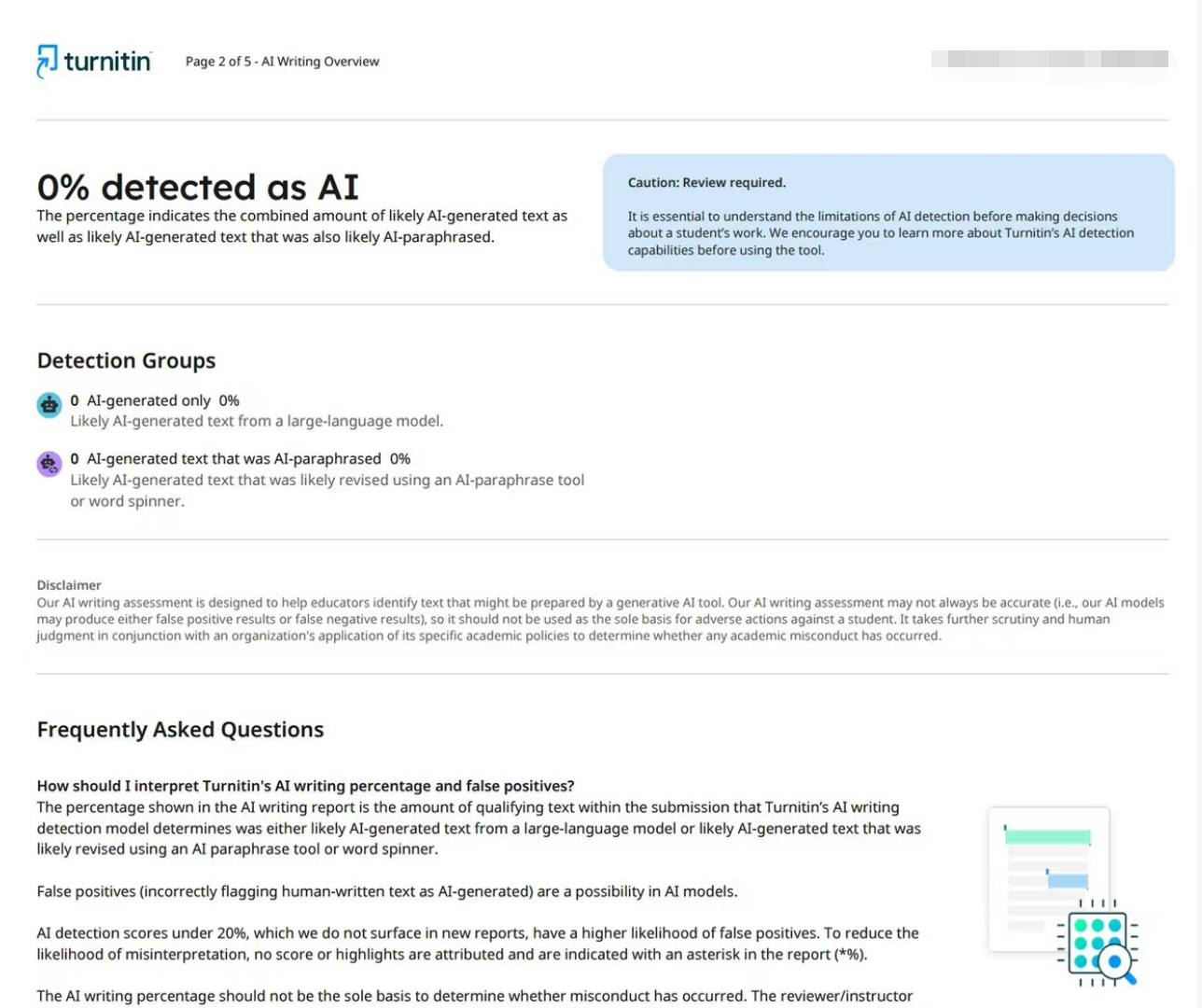
| 0% | No AI-generated writing was detected with sufficient confidence. Entirely human-written or below detection threshold. |
| 1–20% | Very little text resembles AI writing. This often occurs naturally because common phrases, definitions, or formulaic language appear in many academic papers. |
| 21–40% | Some passages display AI-like characteristics. This is not unusual for well-structured academic writing and should be reviewed rather than assumed to be AI-generated. |
| 41–60% | A noticeable portion of the document contains language patterns associated with AI writing. Human review becomes increasingly important. |
| 61–80% | A substantial amount of the text is predicted to resemble AI-generated writing. Additional context and evidence should be considered before drawing conclusions. |
| 81–100% | Most of the document demonstrates characteristics commonly associated with AI-generated content. Even so, this is not definitive proof that AI was used. |
What Turnitin’s AI Writing Percentage Measures
Turnitin’s AI writing indicator focuses on text characteristics, not user behavior.
Specifically, it analyzes features such as:
- Sentence predictability
- Linguistic consistency
- Vocabulary distribution
- Writing rhythm
- Structural repetition
- Statistical language patterns
Large language models like ChatGPT tend to produce highly fluent and statistically predictable text. Turnitin’s detector attempts to recognize these patterns across longer passages.
Importantly, the percentage does not measure intent.
A student who used AI extensively and carefully revised the output may receive a relatively low score, while an experienced academic writer producing highly formal prose could receive a higher score than expected.
The indicator therefore reflects text similarity to AI-generated language, not actual AI usage.
What the AI Percentage Is Not
Understanding what the score doesn’t represent is just as important.
The AI percentage is not:
- A plagiarism score
- A certainty score
- Proof that AI tools were used
- A disciplinary recommendation
- A measure of academic integrity
- Evidence of intentional misconduct
For example, a paper showing 70% AI writing is not saying there is a 70% chance the student used ChatGPT.
Likewise, a 0% score does not guarantee that AI was never involved. It simply means the submitted text did not exhibit enough detectable AI writing patterns.
Think of the indicator as a screening tool, similar to plagiarism matching. It highlights content that deserves closer review rather than delivering a final verdict.
How Turnitin’s AI Indicator Works (High-Level)
Turnitin has not publicly disclosed its complete detection algorithms, but its overall approach can be understood at a high level.
Rather than searching for specific AI-generated phrases, the system evaluates statistical characteristics across larger sections of text.
The process generally involves:
- Breaking the submission into analyzable text segments.
- Examining linguistic and statistical writing patterns.
- Comparing those patterns with characteristics commonly observed in AI-generated writing.
- Calculating an overall percentage of text that appears consistent with those patterns.
The system is designed to reduce false positives by avoiding conclusions based on isolated sentences. Instead, it evaluates writing across longer passages where AI-generated patterns become more statistically meaningful.
This explains why very short assignments or documents containing limited original writing may not receive an AI score at all.
Practical Guidance for Educators
Try it now!
The most effective way to use Turnitin’s AI indicator is as one piece of a broader academic integrity review.
Rather than focusing solely on the percentage, educators should consider additional evidence, including:
- The student’s previous writing style
- Draft history and revision records
- Writing process documentation
- In-class writing samples
- Source citations and references
- Opportunities for the student to explain their work
A high AI score should begin a conversation—not end one.
Similarly, a low score should not automatically eliminate concerns if other evidence suggests inappropriate AI assistance.
Ultimately, academic integrity decisions are strongest when they combine technology with professional judgment. AI detection tools provide valuable insights, but they work best when interpreted alongside context, evidence, and educator expertise.
Final Thoughts
Turnitin’s AI Detection Score is best understood as a risk indicator rather than a verdict. It estimates how much of a document resembles AI-generated writing based on linguistic patterns, but it cannot determine authorship, intent, or academic honesty on its own.
Whether the score is 0% or 100%, the number should always be interpreted carefully and in context. By understanding what the AI percentage measures—and what it does not—educators can make more informed, fair, and balanced decisions while supporting responsible use of AI in education.