GPTZero Review 2026: Is It the Most Accurate AI Content Detector Available Today?
As AI-generated writing becomes increasingly sophisticated, distinguishing between human-written and machine-generated content has become one of the biggest challenges in education, publishing, journalism, and content marketing. From ChatGPT and GPT-5 to Claude, Gemini, and DeepSeek, large language models can now produce text that closely resembles human writing.
Among the growing number of AI detection platforms, GPTZero has emerged as one of the most respected names in the industry. Originally developed for educators concerned about academic integrity, GPTZero has evolved into a comprehensive AI detection platform used by teachers, universities, publishers, recruiters, and businesses worldwide.
But how does GPTZero actually work? How accurate is it compared to competitors such as Turnitin and ZeroGPT? And is it worth using in 2026?
Let’s take a detailed look.
1. How GPTZero Detects AI-Generated Content
GPTZero was originally designed around two linguistic concepts:
- Perplexity
- Burstiness
These metrics helped identify patterns commonly found in AI-generated writing.
However, GPTZero’s modern detection engine has evolved far beyond those early approaches.
Today, GPTZero utilizes a multi-layer machine learning architecture trained on millions of human-written and AI-generated documents. Rather than relying on a single metric, the system analyzes numerous signals simultaneously, including: - Sentence predictability
- Vocabulary distribution
- Structural consistency
- Semantic coherence
- Stylistic variation
- Context transitions
- Human editing patterns
The detector is trained using outputs from major AI systems, including: - ChatGPT
- GPT-4
- GPT-5
- Claude
- Gemini
- DeepSeek
- Llama
- Mistral
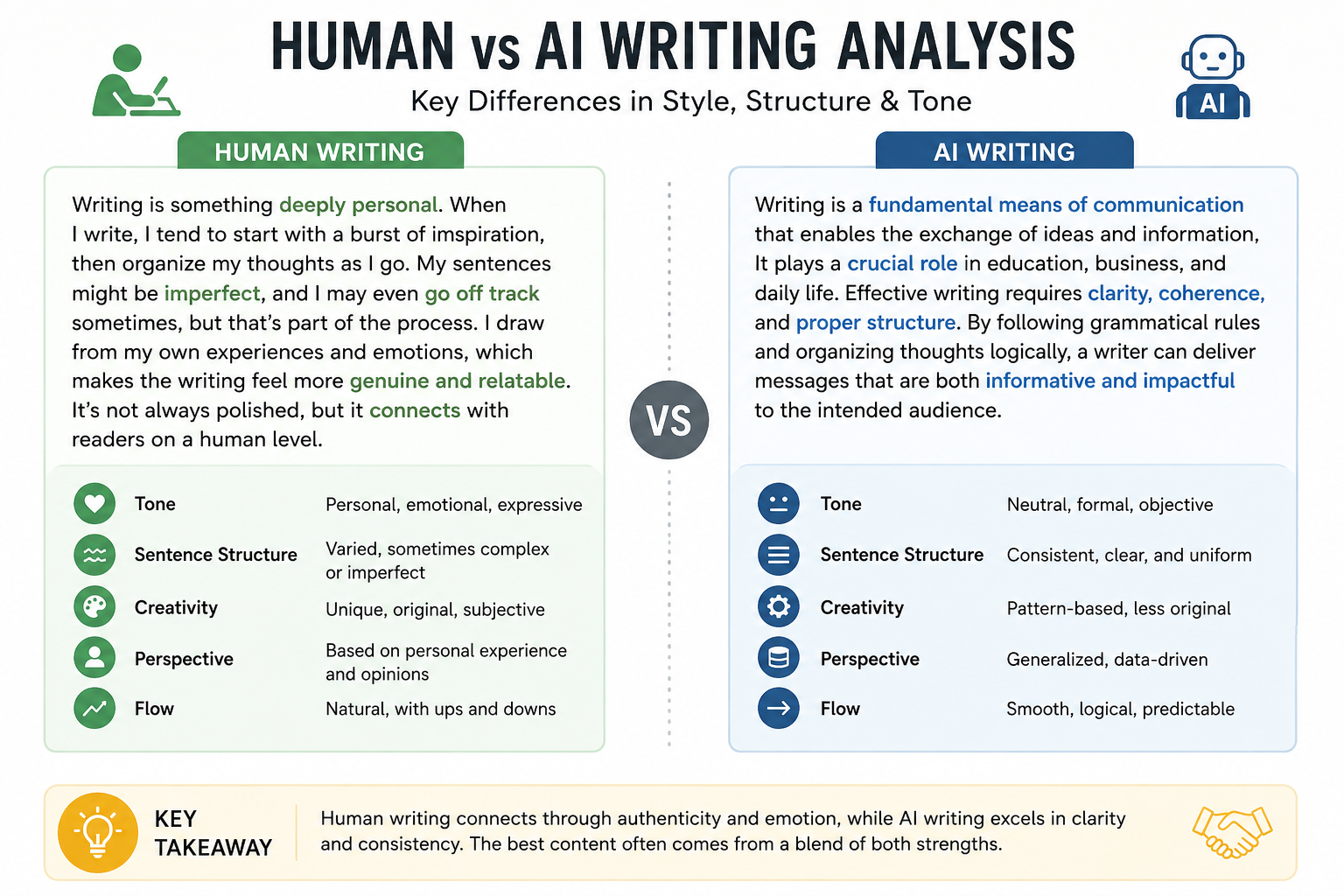
GPTZero attempts to identify subtle characteristics that often appear in AI writing: - Excessively uniform sentence lengths
- Predictable word choices
- Consistent paragraph structures
- Lack of natural stylistic variation
- Overly polished transitions
Unlike simple AI checkers that generate a single percentage score, GPTZero provides a detailed analysis showing: - AI probability score
- Sentence-level highlights
- Human vs AI writing breakdown
- Writing pattern explanations
- Confidence levels
This transparent approach helps users understand why a text was flagged rather than simply presenting a black-box verdict.
2. GPTZero Features: More Than an AI Detector
Over the last two years, GPTZero has expanded from a detection tool into a broader content verification platform.
Its flagship feature remains the AI Content Detector, but several additional tools have been added.
Core Detection Features
- AI writing detection
- Sentence-level highlighting
- Paragraph-level analysis
- Confidence scoring
- Batch document scanning
- PDF and DOCX support
Educator Tools
GPTZero has become particularly popular among schools and universities because it offers:
- Classroom integrations
- LMS compatibility
- Assignment monitoring
- Student writing reports
- Authorship verification
Chrome Extension
One of GPTZero’s strongest advantages is its browser extension, which allows users to analyze content directly on websites, Google Docs, and online platforms.
Writing Reports
GPTZero generates detailed reports showing:
- Percentage of AI-generated content
- Highlighted suspicious passages
- Writing pattern analysis
- Downloadable evidence reports
Enterprise Solutions
Organizations can access:
- API integrations
- Team management
- Workflow automation
- Bulk document analysis
- Custom reporting dashboards
The platform has become especially attractive to publishers and agencies that need to verify large volumes of content efficiently.
3. GPTZero Accuracy: Real-World Performance in 2026
Accuracy is where GPTZero truly differentiates itself from many competitors.
The company regularly publishes benchmark results claiming detection rates above 98% for modern AI models.
More importantly, many independent evaluations conducted throughout 2025 and 2026 have shown GPTZero consistently ranking among the top-performing AI detectors available.
Strengths
GPTZero performs particularly well when detecting:
- Pure ChatGPT outputs
- GPT-4 and GPT-5 generated content
- Claude-generated essays
- Long-form AI articles
- AI-assisted academic writing
In many benchmark tests, GPTZero successfully identifies obvious AI content with extremely high confidence.
False Positives
One of the most important metrics for any AI detector is the false-positive rate.
A false positive occurs when genuinely human-written text is incorrectly labeled as AI-generated.
Compared with many competing tools, GPTZero generally maintains a lower false-positive rate.
This is particularly important for:
- Students
- Journalists
- Researchers
- Professional writers
because incorrect accusations can have serious consequences.
Areas Where GPTZero Struggles
Like every AI detector, GPTZero is not perfect.
Challenges remain when analyzing:
- Heavily edited AI content
- Human-AI collaborative writing
- Very short documents
- Technical documentation
- Non-native English writing
When AI-generated text has been extensively revised by humans, detection accuracy naturally decreases.
This limitation affects every major detector currently available.
Practical Reliability
For everyday use, GPTZero generally provides reliable guidance.
Most experts recommend viewing results as:
Strong indicators rather than definitive proof.
The best practice remains combining detector results with human review and contextual evidence.
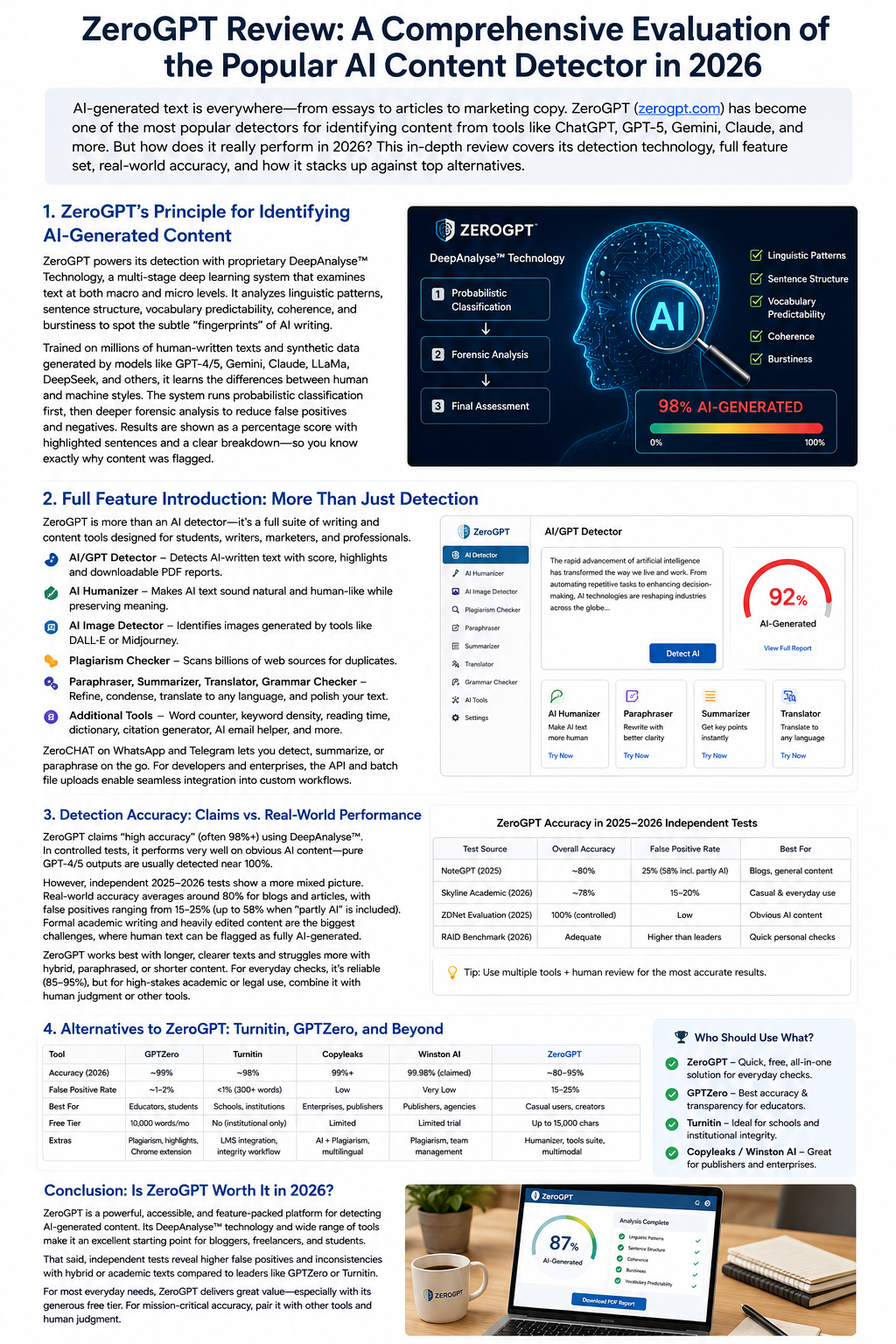
4. GPTZero vs Turnitin vs ZeroGPT

The AI detection market has become increasingly competitive.
Let’s compare the three most discussed platforms.
| Feature | GPTZero | Turnitin | ZeroGPT |
|---|---|---|---|
| Individual Access | ✅ | ❌ | ✅ |
| Educational Focus | ✅ | ✅ | ⚠️ |
| AI Detection Accuracy | Very High | Very High | Moderate–High |
| False Positive Rate | Low | Very Low | Higher |
| Free Version | ✅ | ❌ | ✅ |
| Browser Extension | ✅ | ❌ | Limited |
| API Access | ✅ | Institutional | ✅ |
| Plagiarism Detection | Limited | Strong | Strong |
| LMS Integration | Growing | Excellent | Limited |
GPTZero
Best for:
- Teachers
- Students
- Publishers
- Content reviewers
Strengths: - Strong detection accuracy
- Transparent reports
- Low false-positive rates
Turnitin
Best for:
- Universities
- Colleges
- Educational institutions
Strengths: - Deep academic integrations
- Large historical writing database
- Institutional workflows
Weaknesses: - Not available directly to most individuals
ZeroGPT
Best for:
- Casual users
- Bloggers
- Freelancers
Strengths: - Free access
- Large tool ecosystem
- Simple interface
Weaknesses: - More inconsistent results in independent testing
Conclusion: Is GPTZero Worth Using in 2026?
GPTZero has matured into one of the most capable AI content detection platforms available today. Its modern detection architecture, educator-focused design, transparent reporting system, and strong real-world accuracy make it a leading choice for individuals and organizations seeking reliable AI detection.
While no detector can guarantee perfect results—especially as AI models continue to improve—GPTZero consistently performs better than many alternatives when balancing detection accuracy and false-positive risk.
For educators, publishers, content teams, and students who need trustworthy AI detection without institutional barriers, GPTZero remains one of the strongest options available in 2026.
Final Verdict
Rating: 9.2 / 10
✅ Excellent detection accuracy
✅ Strong transparency and reporting
✅ Low false-positive rates
✅ Useful browser and classroom integrations
⚠️ Less effective on heavily human-edited AI content
⚠️ Premium features required for advanced workflows
If you’re looking for a dependable AI detector that combines accessibility with professional-grade analysis, GPTZero is absolutely worth considering.